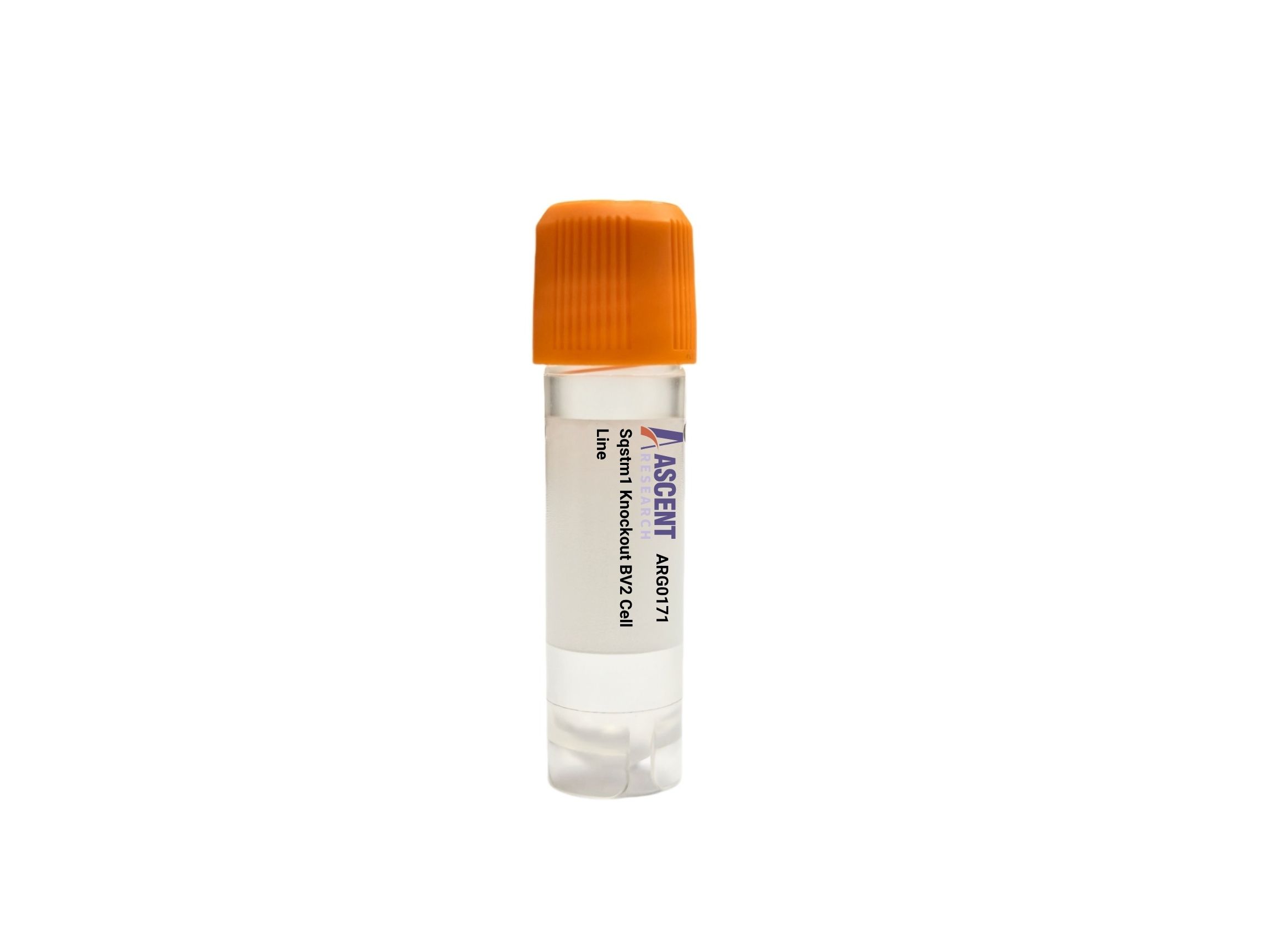
Genome-edited Cells
Sqstm1 Knockout BV2 is a CRISPR/Cas9-edited mouse microglia-like cell line with disruption of the selective autophagy receptor SQSTM1/p62. In the widely used BV2 neuroinflammation model, SQSTM1 links ubiquitinated cargo to MAP1LC3/LC3-positive autophagosomes and modulates KEAP1-NFE2L2/NRF2 and TRAF6-NF-kB signaling. This knockout model supports studies of autophagic flux, lysosomal cargo clearance, oxidative stress responses, protein aggregate handling, and microglial inflammatory signaling. Typical applications include western blotting, RT-qPCR, RNA-seq, immunofluorescence, cytokine secretion assays, ROS assays, phagocytosis assays, and drug-response studies in proteostasis and innate immune pathways.
 CETN2 Knockout A2780 Polyclonal Cells
Cat. No. ARG18808
HSPB1 Knockout MES-OV Polyclonal Cells
Cat. No. ARG24585
ABLIM3 Knockout MES-OV Polyclonal Cells
Cat. No. ARG24008
HSF1 Knockout KYSE30 Polyclonal Cells
Cat. No. ARG36308
CAPN2 Knockout MES-OV Polyclonal Cells
Cat. No. ARG42198
CETN2 Knockout A2780 Polyclonal Cells
Cat. No. ARG18808
HSPB1 Knockout MES-OV Polyclonal Cells
Cat. No. ARG24585
ABLIM3 Knockout MES-OV Polyclonal Cells
Cat. No. ARG24008
HSF1 Knockout KYSE30 Polyclonal Cells
Cat. No. ARG36308
CAPN2 Knockout MES-OV Polyclonal Cells
Cat. No. ARG42198
 Mouse Bladder Smooth Muscle Cell Medium
Cat. No. ARM0500
Mouse Bladder Smooth Muscle Cell Medium
Cat. No. ARM0500
The Sqstm1 Knockout BV2 Cell Line is a CRISPR/Cas9-engineered mouse cell model in which the endogenous Sqstm1 locus has been disrupted to eliminate functional SQSTM1/p62 expression. This stable knockout line is generated in BV2 cells, an immortalized murine microglia-like cell line, and provides an in vitro system for investigating the consequences of SQSTM1 loss in a CNS-relevant innate immune background. The model is suited for mechanistic studies of autophagy, stress signaling, proteostasis, and inflammatory pathway regulation in microglial cells.
BV2 cells are widely used as a tractable surrogate for activated microglia in studies of neuroinflammation, phagocytosis, innate immune signaling, and glia-mediated responses to cellular stress. As a murine microglia-like immortalized cell line, BV2 retains experimental relevance for pathways involved in central nervous system immune surveillance and inflammatory activation, while offering the scalability and reproducibility needed for biochemical, imaging, and screening workflows. This background makes BV2 particularly useful for modeling processes linked to neurodegeneration, protein aggregate handling, oxidative stress, and inflammatory cytokine production.
SQSTM1 encodes p62, a ubiquitin-binding scaffold and selective autophagy receptor that links polyubiquitinated cargo to LC3-positive autophagosomes through interactions with ubiquitin and MAP1LC3/LC3 family proteins. SQSTM1 functions within selective autophagy and macroautophagy networks involving ATG5, ATG7, BECN1, ULK1, and RB1CC1/FIP200, and is regulated by nutrient status, MTOR, AMPK, oxidative stress, proteotoxic stress, and inflammatory stimuli including TLR4 activation and TNF signaling. Beyond cargo sequestration, p62 interacts with KEAP1 to influence NFE2L2/NRF2-dependent oxidative stress responses and associates with signaling factors such as TRAF6 and RIPK1 that mediate NF-kB-responsive inflammatory outputs. Through these mechanisms, SQSTM1 acts at the intersection of lysosomal degradation, ubiquitin-proteasome crosstalk, aggregate clearance, redox adaptation, and innate immune signaling, all of which are relevant to neurodegeneration, ALS, frontotemporal dementia, proteinopathy research, and inflammatory disorders.
Loss of Sqstm1 in BV2 cells therefore provides a useful platform for dissecting how selective autophagy interfaces with microglial inflammatory activation and stress adaptation. In a microglial context, disruption of p62 can be used to examine pathway dependency between autophagic flux and cytokine signaling, the handling of ubiquitinated protein aggregates, KEAP1 sequestration and NRF2 target gene regulation, and downstream consequences for lysosomal cargo clearance, ROS control, and cell survival under inflammatory or proteotoxic challenge.
This cell line is suitable for western blotting and LC3/p62 turnover analysis, autophagic flux assays, immunofluorescence imaging of LC3-positive structures and protein aggregates, RT-qPCR or RNA-seq analysis of NRF2 target genes and NF-kB-responsive cytokines, cytokine secretion assays after TLR4 or TNF stimulation, ROS measurements, phospho-signaling studies, co-immunoprecipitation of pathway complexes, phagocytosis assays, flow cytometry, lysosomal activity measurements, and reporter-based interrogation of autophagy, oxidative stress, or inflammatory signaling. It can also support drug-response studies aimed at defining how modulation of MTOR, AMPK, lysosomal function, or proteostasis pathways depends on SQSTM1 in microglia-like cells. Researchers may contact Ascent Research for additional technical information, product details, or related gene-edited cell models.