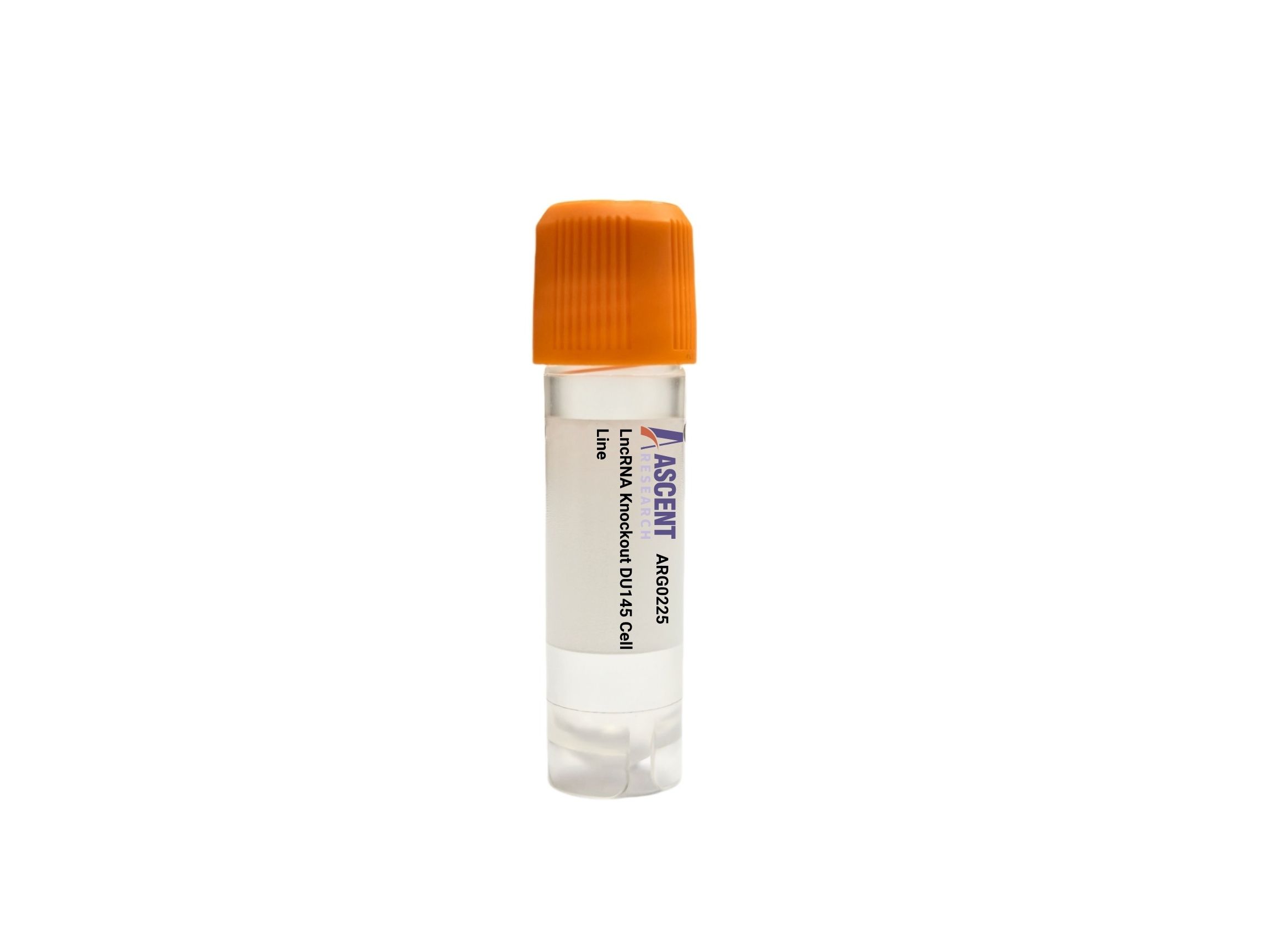
Genome-edited Cells
Prostate
The LncRNA Knockout DU145 Cell Line is a CRISPR/Cas9-edited knockout cell line derived from DU145 prostate cancer cells. It features targeted disruption of LncRNA, a gene that scaffolds the PRC2 complex and sponges oncogenic miRNAs to regulate proliferation and invasion. Knockout of LncRNA derepresses tumor suppressors and inhibits signaling through AR, PI3K/AKT, and Wnt/??-catenin pathways. This model enables detailed investigation of LncRNA??s role in prostate cancer metastasis and epithelial-mesenchymal transition, and is suited for functional genomics, drug screening, and therapeutic target validation using assays such as RNA-seq, Western blotting, proliferation, and Transwell migration/invasion assays.
 ATP2B2 Knockout Hela Polyclonal Cells
Cat. No. ARG20962
HMGN5 Knockout MES-OV Polyclonal Cells
Cat. No. ARG24553
HORMAD1 Knockout HEK293T Polyclonal Cells
Cat. No. ARG38088
GCLM Knockout CaSki Polyclonal Cells
Cat. No. ARG9922
CTNNB1 Knockout THP-1 Polyclonal Cells
Cat. No. ARG7338
CMTM6 Knockout Raji Polyclonal Cells
Cat. No. ARG1884
ATP2B2 Knockout Hela Polyclonal Cells
Cat. No. ARG20962
HMGN5 Knockout MES-OV Polyclonal Cells
Cat. No. ARG24553
HORMAD1 Knockout HEK293T Polyclonal Cells
Cat. No. ARG38088
GCLM Knockout CaSki Polyclonal Cells
Cat. No. ARG9922
CTNNB1 Knockout THP-1 Polyclonal Cells
Cat. No. ARG7338
CMTM6 Knockout Raji Polyclonal Cells
Cat. No. ARG1884
The LncRNA Knockout DU145 Cell Line is a CRISPR/Cas9-edited knockout cell line derived from DU145 human prostate adenocarcinoma cells. This model features CRISPR/Cas9-mediated disruption of the LncRNA gene, creating a loss-of-function system for investigating LncRNA??s roles in gene regulation, chromatin organization, and epigenetic scaffolding. The knockout cell line is provided as a heterogeneous population suitable for advanced biomedical research in functional genomics and cancer biology.
DU145 is an epithelial prostate cancer cell line originally isolated from a brain metastasis of prostate adenocarcinoma. It serves as a widely used model for metastatic castration-resistant prostate cancer (mCRPC), exhibiting aggressive invasive potential and activation of alternative signaling pathways. This background makes DU145 ideal for studying mechanisms of prostate cancer metastasis, particularly to the central nervous system.
LncRNA acts as a molecular scaffold bridging PRC2 complex and chromatin remodelers to specific genomic loci, regulating transcription. It also functions as a ceRNA, sponging oncogenic miRNAs to modulate target mRNA stability. LncRNA expression is controlled by upstream regulators including MYC, p53, and androgen receptor signaling. Downstream, it influences EZH2, Cyclin D1, and MMP9, and interacts with hnRNP proteins. Through these interactions, LncRNA integrates PI3K/AKT, Wnt/??-catenin, and EMT pathways to promote proliferation and invasion.
LncRNA knockout in DU145 attenuates epigenetic scaffolding and miRNA sponging, derepressing tumor suppressors and inhibiting proliferative and invasive signals. This enables dissection of LncRNA??s role in regulating E-cadherin, Vimentin, ??-catenin, and AKT phosphorylation. The model is physiologically relevant for studying EMT and metastatic competence acquisition in brain-metastatic prostate cancer.
Typical research applications for this product include functional characterization of LncRNA using transcriptomic and proteomic approaches such as RNA-seq and Western blotting, as well as RT-qPCR for gene expression analysis. Cell-based assays, including proliferation assays (e.g., MTT or EdU incorporation) and Transwell migration/invasion assays, allow quantitative assessment of tumor cell aggressiveness. Biochemical interaction studies can be performed via RNA pull-down and ChIP-qPCR to validate LncRNA binding partners and chromatin occupancy. Furthermore, the cell line is well-suited for therapeutic target validation experiments and drug sensitivity screens. For further information, custom project inquiries, or technical support, please contact Ascent Research.