Genome-edited Cells
Uterus (cervix)
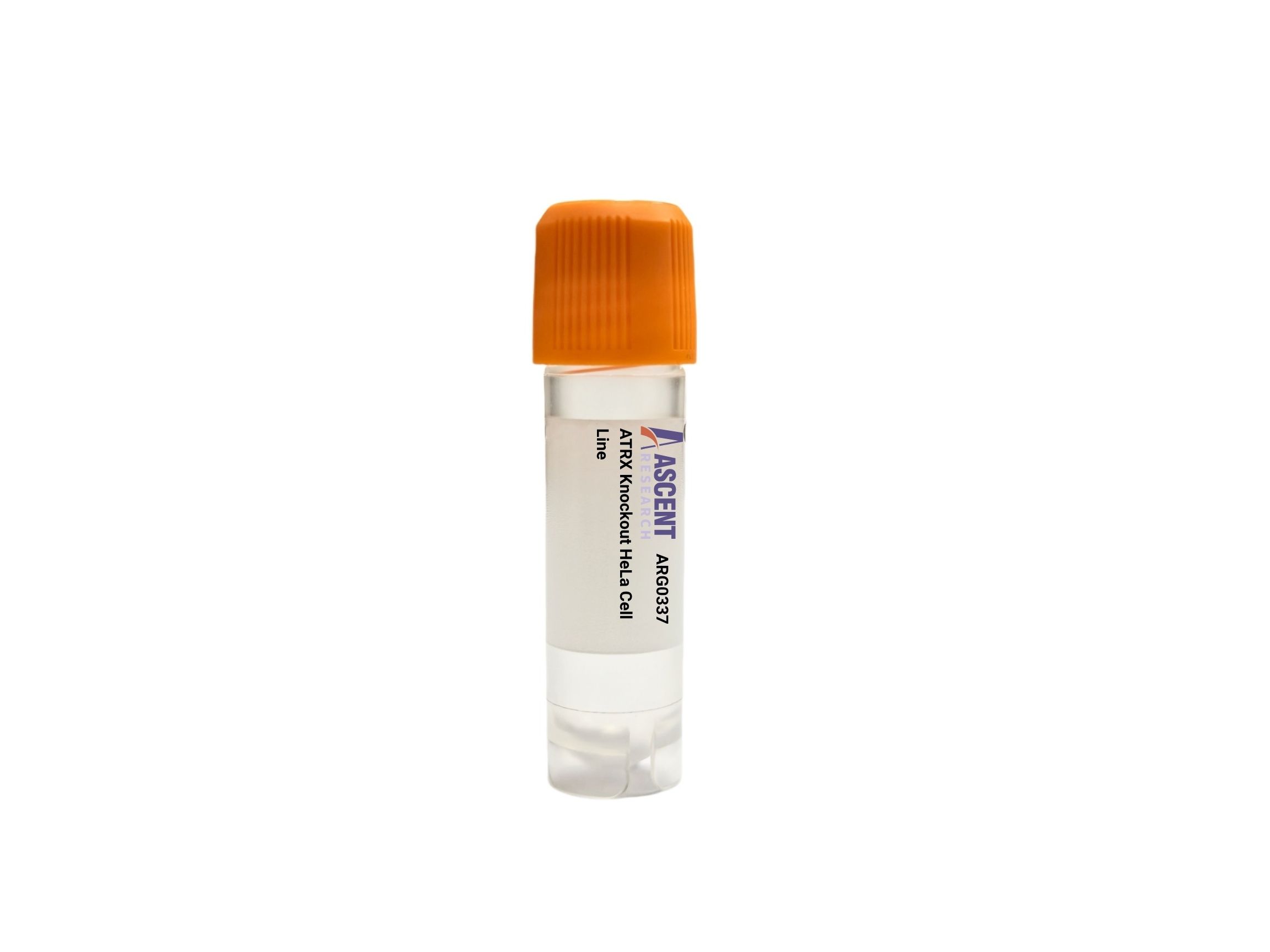
The ATRX Knockout HeLa Cell Line is a CRISPR/Cas9-edited human cervical adenocarcinoma cell model with targeted disruption of the ATRX gene, a key chromatin remodeler that cooperates with DAXX to deposit histone H3.3 at heterochromatic regions. This loss-of-function model is ideal for investigating chromatin dynamics, telomere maintenance, and DNA repair in a p53- and Rb-deficient background. ATRX interacts with HP1??, PML, and DNA-PKcs and is regulated by ATM/ATR kinases; its knockout leads to H3.3 mislocalization and genome instability. Applications include ChIP, telomere assays, RNA-seq, and drug sensitivity screens, making it valuable for cancer epigenetics and therapeutic research.
 LBR Knockout A2780 Polyclonal Cells
Cat. No. ARG18509
CRIP1 Knockout NCI-H1975 Polyclonal Cells
Cat. No. ARG16347
ARHGAP32 Knockout NCI-H1299 Polyclonal Cells
Cat. No. ARG30401
DMTN Knockout HAP1 Polyclonal Cells
Cat. No. ARG38993
COG5 Knockout MES-OV Polyclonal Cells
Cat. No. ARG6080
CYFIP1 Knockout HEK293T Polyclonal Cells
Cat. No. ARG3253
LBR Knockout A2780 Polyclonal Cells
Cat. No. ARG18509
CRIP1 Knockout NCI-H1975 Polyclonal Cells
Cat. No. ARG16347
ARHGAP32 Knockout NCI-H1299 Polyclonal Cells
Cat. No. ARG30401
DMTN Knockout HAP1 Polyclonal Cells
Cat. No. ARG38993
COG5 Knockout MES-OV Polyclonal Cells
Cat. No. ARG6080
CYFIP1 Knockout HEK293T Polyclonal Cells
Cat. No. ARG3253
The ATRX Knockout HeLa Cell Line is a CRISPR/Cas9-edited knockout cell line engineered for loss-of-function studies of the ATRX gene encoding a SWI/SNF-type chromatin remodeler. This product provides a genetically defined human cell model in which CRISPR/Cas9-mediated gene disruption ablates ATRX expression, enabling researchers to interrogate its roles in chromatin dynamics, genome stability, and epigenetic regulation.
The host cell line, HeLa, is an epithelial cervical adenocarcinoma line transformed by human papillomavirus type 18 (HPV18). The viral oncoproteins E6 and E7 inactivate the tumor suppressors p53 and Rb, respectively, creating a genetic background permissive to proliferation and commonly used in cancer biology, virology, and drug development. These cells serve as a robust platform for studying ATRX function in a context of compromised cell-cycle checkpoints.
ATRX functions as an ATP-dependent chromatin remodeler that partners with the histone chaperone DAXX to deposit the histone variant H3.3 at pericentromeric heterochromatin, telomeres, and other repetitive genomic regions. This activity facilitates DNA replication through these challenging sequences and contributes to the maintenance of genome stability. Upstream, ATRX is regulated by replication stress signals and kinases such as ATM and ATR, while its downstream effects include proper H3.3 localization, telomere maintenance, and silencing of repetitive elements. ATRX interacts with DAXX, HP1??, the cohesin complex, PML protein, and DNA-PKcs, and it intersects with pathways involving HIRA, ATM, and ATR. Through these interactions, ATRX influences non-homologous end joining, DNA damage response, and transcriptional regulation, particularly of the ??-globin gene cluster and retroviral transposable elements.
Disruption of ATRX in HeLa cells results in mislocalization of H3.3, chromosomal instability, and impaired DNA repair, mirroring phenotypes observed in cancers with ATRX mutations, such as gliomas, sarcomas, and pancreatic neuroendocrine tumors. This knockout model is particularly valuable for dissecting the molecular consequences of ATRX loss in a cell line with deficient p53 and Rb, which may accentuate dependency on alternative DNA repair pathways. It enables the study of how chromatin remodeling defects contribute to oncogenesis and influence sensitivity to therapeutic agents.
Researchers can employ this cell line in a range of experimental workflows, including chromatin immunoprecipitation (ChIP-qPCR) to assess H3.3 occupancy at telomeres, immunofluorescence for ATRX and H3.3 localization, Western blotting to confirm knockout, telomere length analysis by TRF, and comet assays to evaluate DNA damage. Applications extend to global transcriptomic profiling via RNA-seq, functional dissection of ATRX-interacting partners through co-immunoprecipitation, and drug sensitivity screens to identify synthetic lethal interactions or chemoresistance mechanisms. For further details or custom requirements, please contact Ascent Research.