Genome-edited Cells
Uterus (cervix)
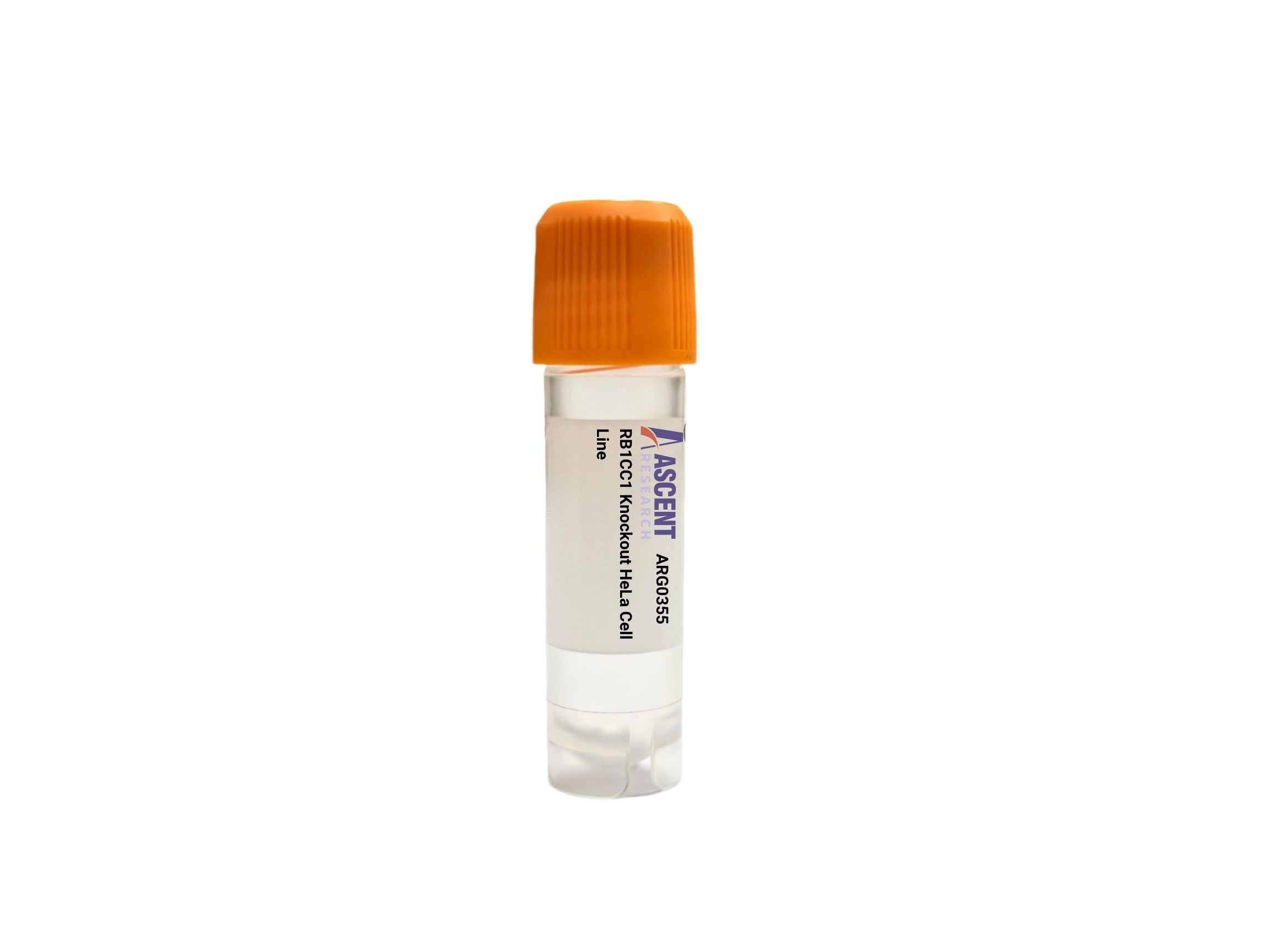
The RB1CC1 Knockout HeLa Cell Line is a CRISPR/Cas9-edited knockout cell line based on the HeLa cervical adenocarcinoma model. It enables targeted loss-of-function studies of RB1CC1 (FIP200), a critical scaffold protein that assembles the ULK1-ATG13-FIP200 complex to initiate autophagy and interfaces with mTORC1 and FAK signaling. This knockout line is particularly suited for dissecting mTORC1-dependent autophagy, studying cancer cell biology, and evaluating drug resistance mechanisms. Representative assays include LC3/p62 flux measurements, co-immunoprecipitation of autophagy complexes, phospho-signaling profiling, and cell viability screens in cervical cancer research.
 CANX Knockout AGS Polyclonal Cells
Cat. No. ARG42119
NOS1AP Knockout NCI-H1299 Polyclonal Cells
Cat. No. ARG17443
IDO1 Knockout Raji Polyclonal Cells
Cat. No. ARG23434
EFHD1 Knockout 786-O Polyclonal Cells
Cat. No. ARG40644
GCC2 Knockout AGS Polyclonal Cells
Cat. No. ARG2684
MAP3K5 Knockout AGS Polyclonal Cells
Cat. No. ARG2140
CANX Knockout AGS Polyclonal Cells
Cat. No. ARG42119
NOS1AP Knockout NCI-H1299 Polyclonal Cells
Cat. No. ARG17443
IDO1 Knockout Raji Polyclonal Cells
Cat. No. ARG23434
EFHD1 Knockout 786-O Polyclonal Cells
Cat. No. ARG40644
GCC2 Knockout AGS Polyclonal Cells
Cat. No. ARG2684
MAP3K5 Knockout AGS Polyclonal Cells
Cat. No. ARG2140
The RB1CC1 Knockout HeLa Cell Line is a CRISPR/Cas9-edited knockout cell line derived from the HeLa cervical adenocarcinoma cell line. This cell line harbors a disruption in the RB1CC1 gene, generated using CRISPR/Cas9-mediated gene editing, to provide a stable loss-of-function model for studying autophagy initiation and related signaling pathways.
HeLa cells are an immortalized epithelial cell line originally derived from a cervical adenocarcinoma. They are HPV18-positive and exhibit an aneuploid karyotype, characteristics that have established HeLa as a widely used model for cancer biology and signal transduction studies. Their robust growth and well-characterized signaling networks make them a versatile host for gene knockout investigations.
RB1CC1, also known as FIP200, is a critical scaffold protein that facilitates autophagy initiation by assembling the ULK1-ATG13-FIP200 complex. It functions downstream of nutrient and energy sensors, including mTORC1 and AMPK, and interacts directly with ULK1, ATG13, ATG101, and FAK. Through these interactions, RB1CC1 integrates signals from upstream regulators such as RB1 and mTORC1 to control ULK1 kinase activity and promote the formation of autophagosomes. Disruption of RB1CC1 impairs this initiation complex, leading to defective autophagic flux and altered mTORC1 signaling, providing a powerful tool to dissect the molecular hierarchy of autophagy.
In the HeLa background, RB1CC1 knockout generates a pertinent model for investigating autophagy-dependent processes in cervical adenocarcinoma. Given the established role of autophagy in tumor maintenance and therapy resistance, this knockout cell line enables the examination of RB1CC1-dependent effects on cancer cell proliferation, survival, and response to chemotherapeutic agents. The HPV18-positive, aneuploid nature of HeLa cells further provides a relevant context for exploring interactions between viral oncogenesis and autophagy regulation.
Researchers can employ this cell line for a diverse range of functional studies, including western blotting for autophagy markers, LC3/p62 flux assays to measure autophagic turnover, and phospho-signaling analysis of the mTORC1 axis. Additional applications include co-immunoprecipitation to study protein complex formation, immunofluorescence visualization of autophagic structures, and drug sensitivity assays to assess the role of RB1CC1 in therapeutic response. Its utility in cancer biology, autophagy research, and signal transduction makes it a valuable resource for both mechanistic studies and preclinical drug development. For further information, contact Ascent Research.