Genome-edited Cells
Blood (peripheral blood)
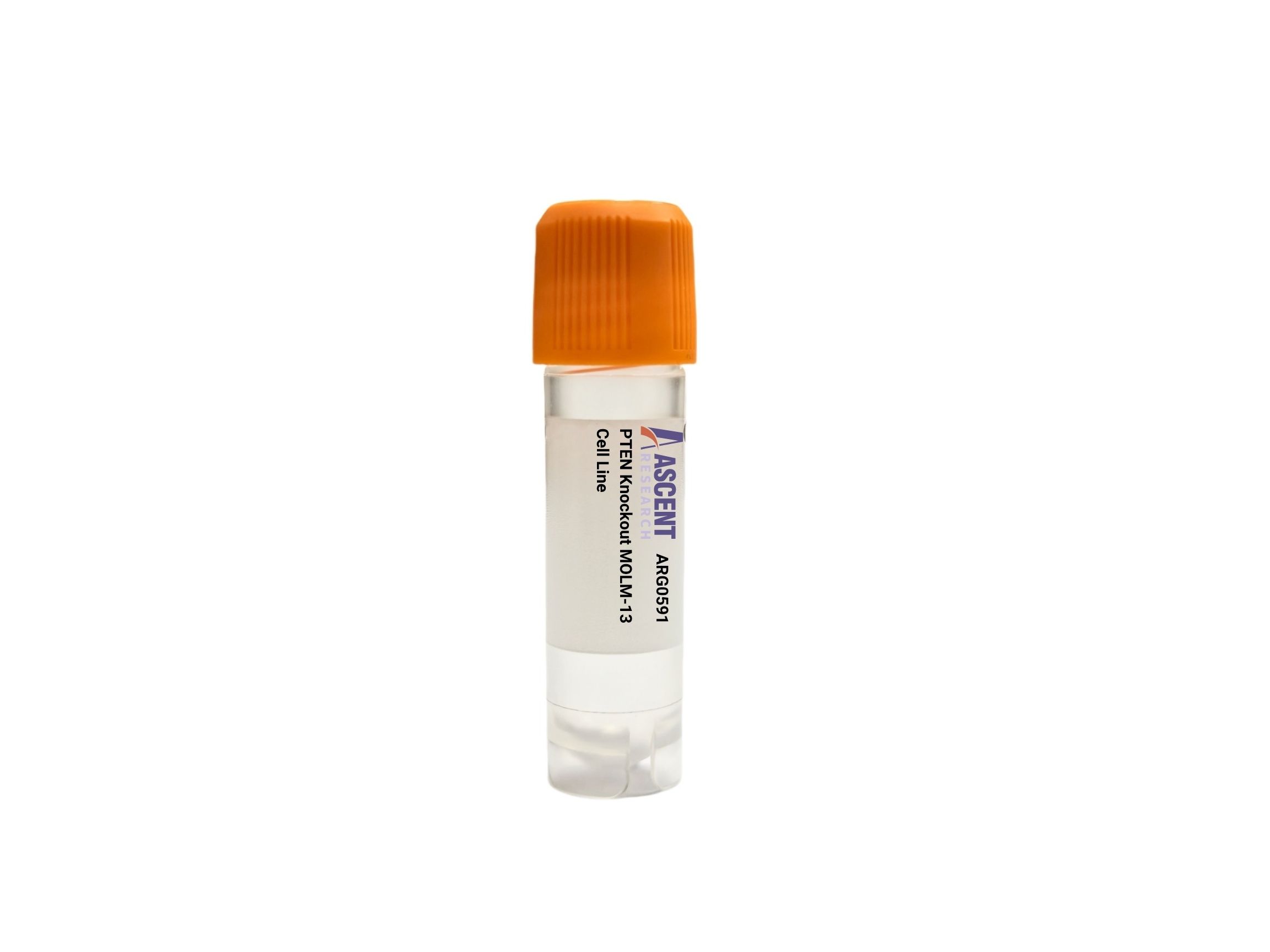
The PTEN Knockout MOLM-13 Cell Line is a CRISPR/Cas9-edited knockout cell line derived from an FLT3-ITD and MLL-AF9 positive acute myeloid leukemia model. PTEN is a tumor suppressor lipid phosphatase that inhibits AKT signaling by dephosphorylating PIP3, thereby regulating cell survival and proliferation. This knockout model enables study of PTEN-dependent PI3K/AKT pathway regulation in AML and is suitable for inhibitor screening, functional genomics, and in vivo xenograft studies. It provides a powerful tool for dissecting tumor suppressor mechanisms and drug resistance in high-risk leukemia.
 BSN Knockout HAP1 Polyclonal Cells
Cat. No. ARG22132
COX19 Knockout jurkat Polyclonal Cells
Cat. No. ARG12805
GOLGB1 Knockout HEK293T Polyclonal Cells
Cat. No. ARG25979
BDH2 Knockout AGS Polyclonal Cells
Cat. No. ARG26750
LPL Knockout Hela Polyclonal Cells
Cat. No. ARG7805
BSN Knockout HAP1 Polyclonal Cells
Cat. No. ARG22132
COX19 Knockout jurkat Polyclonal Cells
Cat. No. ARG12805
GOLGB1 Knockout HEK293T Polyclonal Cells
Cat. No. ARG25979
BDH2 Knockout AGS Polyclonal Cells
Cat. No. ARG26750
LPL Knockout Hela Polyclonal Cells
Cat. No. ARG7805
 RPL19 Knockout Vero Cell Line
Cat. No. ARG0868
RPL19 Knockout Vero Cell Line
Cat. No. ARG0868
The PTEN Knockout MOLM-13 Cell Line is a CRISPR/Cas9-edited knockout cell line derived from the MOLM-13 acute myeloid leukemia (AML) cell line. This model features targeted disruption of the PTEN tumor suppressor gene, providing a defined loss-of-function system for studying PTEN-dependent pathways in AML. The parental MOLM-13 line harbors FLT3-ITD and MLL-AF9 oncogenic lesions, making it a relevant model for AML driven by these mutations. The CRISPR/Cas9-mediated gene disruption enables robust functional studies of PTEN??s role in leukemia biology and targeted therapy development.
MOLM-13 was established from the peripheral blood of a 20-year-old male with relapsed AML M5a and carries both FLT3 internal tandem duplication (FLT3-ITD) and MLL-AF9 fusion. FLT3-ITD constitutively activates downstream signaling including PI3K/AKT, while MLL-AF9 aberrantly regulates gene expression programs that maintain leukemic stemness. This co-occurrence creates a dependency on PI3K/AKT survival signaling, rendering the cells sensitive to PTEN status. MOLM-13 is therefore a widely used model for studying high-risk AML and evaluating targeted inhibitors.
PTEN is a lipid phosphatase that dephosphorylates PIP3 to PIP2, directly antagonizing class I PI3K. This prevents AKT1 membrane recruitment and activation by PDK1, inhibiting downstream mTORC1, S6K, and 4E-BP1. PTEN is regulated by p53, EGR1, and PPAR??, and interacts with MAGI scaffold proteins. Loss of PTEN causes PIP3 accumulation, constitutive AKT activation, and phosphorylation-mediated inhibition of TSC1/TSC2, relieving Rheb-dependent mTORC1 suppression. Active AKT also inactivates FOXO3 and BAD, promoting survival and proliferation. PTEN ubiquitination by NEDD4-1 modulates its stability. PTEN thus restrains the PI3K/AKT/mTOR axis, impacting cell cycle, apoptosis, and genomic stability.
In MOLM-13 cells, PTEN knockout removes a key brake on PI3K/AKT signaling that is already hyperactivated by FLT3-ITD and MLL-AF9. This model enables investigation of PTEN loss on leukemogenesis and drug resistance, particularly in FLT3-ITD-driven AML. It provides a platform to assess whether PTEN deficiency alters sensitivity to FLT3 inhibitors, PI3K/AKT inhibitors, or standard chemotherapeutics. Comparing PTEN-proficient and deficient MOLM-13 cells allows identification of PTEN-specific vulnerabilities and synthetic lethal interactions relevant to AML therapy.
This knockout cell line is suitable for functional assays including Western blotting for PTEN and phospho-AKT, MTS proliferation assays, Annexin V/PI apoptosis assays, and colony formation assays. It can be used in drug sensitivity screens targeting the PI3K pathway and in murine xenograft models to study in vivo leukemic progression. RT-qPCR can monitor FOXO target gene expression. The model also facilitates genetic interaction studies through rescue experiments. For additional information or to inquire about this product, please contact Ascent Research.