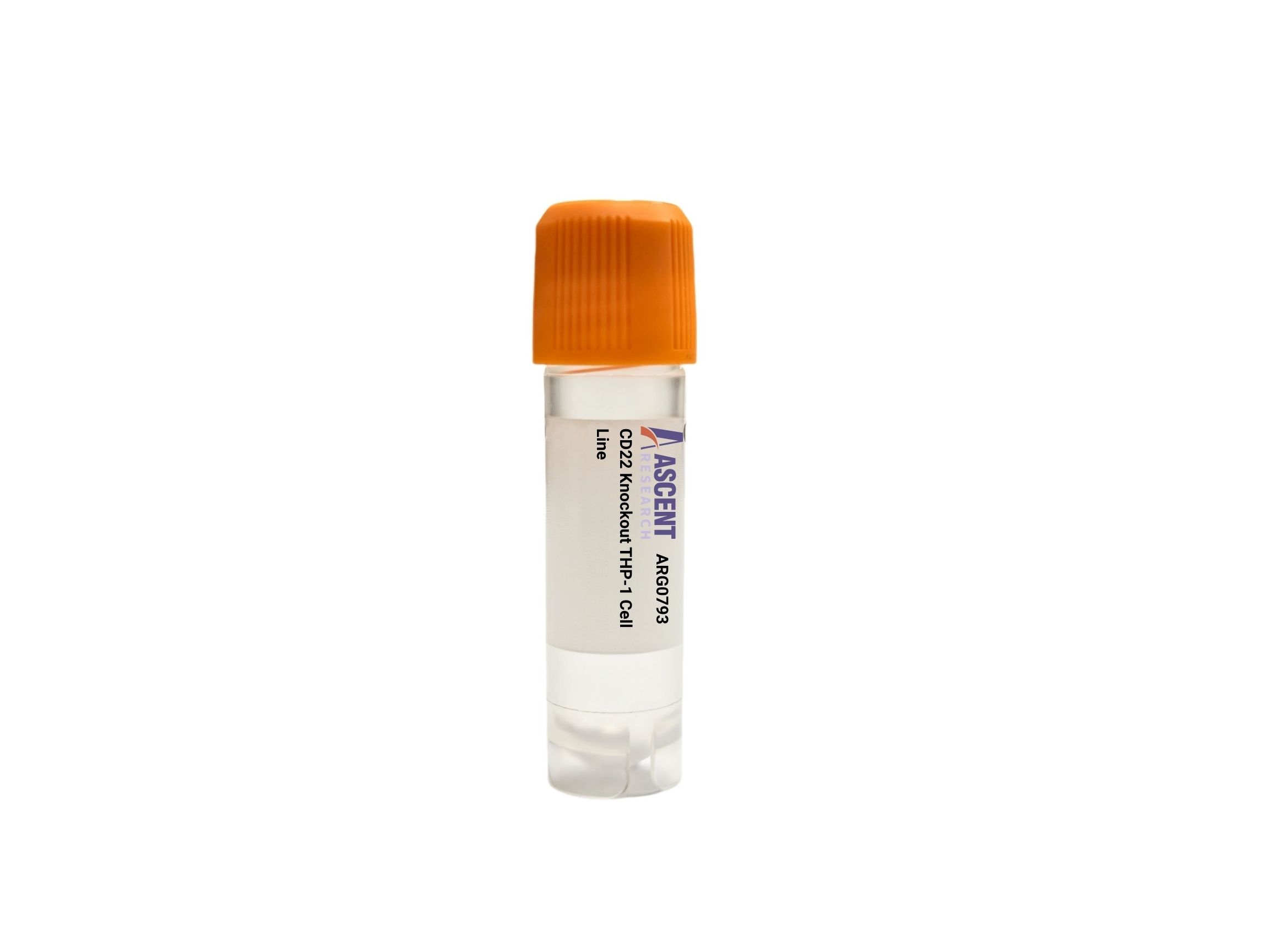
Genome-edited Cells
Blood (peripheral blood)
The CD22 Knockout THP-1 Cell Line is a CRISPR/Cas9-edited human monocytic leukemia cell line with targeted CD22 disruption. In B cells, CD22 acts as an inhibitory co-receptor that recruits SHP-1 and SHIP-1 to dampen BCR signaling; however, THP-1 cells lack native CD22, making this knockout an ideal negative control for studying CD22-independent monocyte/macrophage functions. This model supports CD22-targeted immunotherapy validation, CRISPR efficiency benchmarking, and myeloid immune profiling. It is compatible with Western blotting, flow cytometry, RT-qPCR, phagocytosis assays, cytokine ELISA, and RNA-seq. Contact Ascent Research for further information.
 ADAMTSL4 Knockout Hela Polyclonal Cells
Cat. No. ARG20433
CXCR6 Knockout TE1 Polyclonal Cells
Cat. No. ARG12151
C1S Knockout A549 Polyclonal Cells
Cat. No. ARG31978
KIF1C Knockout SK-HEP-1 Polyclonal Cells
Cat. No. ARG32759
FBXL20 Knockout AGS Polyclonal Cells
Cat. No. ARG2948
ADAMTSL4 Knockout Hela Polyclonal Cells
Cat. No. ARG20433
CXCR6 Knockout TE1 Polyclonal Cells
Cat. No. ARG12151
C1S Knockout A549 Polyclonal Cells
Cat. No. ARG31978
KIF1C Knockout SK-HEP-1 Polyclonal Cells
Cat. No. ARG32759
FBXL20 Knockout AGS Polyclonal Cells
Cat. No. ARG2948
 TYKNU
Cat. No. ARC0965
TYKNU
Cat. No. ARC0965
The CD22 Knockout THP-1 Cell Line is a CRISPR/Cas9-edited human monocytic leukemia cell line with targeted disruption of the CD22 gene. This knockout model serves as a rigorous negative control for CD22-dependent signaling research and facilitates studies of CD22-independent monocyte/macrophage functions. Supplied as a suspension culture, it is suitable for diverse in vitro assays in immunology and oncology.
THP-1 was derived from the peripheral blood of a 1-year-old male with acute monocytic leukemia (AML M5). As a suspension cell line, it is a classic model for monocyte/macrophage differentiation, phagocytosis, cytokine production, and leukemogenesis. Its robust responses to stimuli such as phorbol esters and lipopolysaccharide make it a versatile platform for innate immune and inflammation research.
In B cells, CD22 functions as an inhibitory co-receptor that attenuates B-cell receptor (BCR) signaling by recruiting the phosphatases SHP-1 and SHIP-1. CD22 binds sialylated glycoproteins and is activated by BCR engagement, leading to suppression of downstream kinases including LYN, SYK, and BLNK, and dampening of PLC??2?Cmediated calcium flux and NF-??B activation. CD22 also interacts with CD45, Grb2, and IgM to fine-tune immune tolerance. Since THP-1 cells lack endogenous CD22 expression, this knockout provides a clean genetic background for assessing CD22-specific reagents and for studying myeloid immune mechanisms without CD22 interference.
The CD22 knockout in the THP-1 background offers a well-matched negative control for experiments probing CD22 biology, B-cell malignancies, and immunotherapeutic targeting. It enables stringent validation of anti-CD22 antibody specificity in flow cytometry and Western blotting, and supports benchmarking of CRISPR editing efficiency. Additionally, this model allows dissection of monocyte/macrophage functions??such as phagocytosis and cytokine secretion??in the absence of CD22-related confounding factors, thereby yielding clearer insights into myeloid contributions to leukemia and inflammation.
Key applications include validation of CD22-targeted therapies, negative control in B-cell functional assays, CRISPR knockout efficiency testing, and myeloid lineage immune profiling. Compatible assays encompass Western blotting for CD22 and phospho-proteins, RT-qPCR, flow cytometry, phagocytosis assays, cytokine ELISA, MTT cytotoxicity testing, and RNA-seq. By employing this cell line, researchers can delineate CD22-dependent and -independent pathways in autoimmune diseases, lymphomas, and immune checkpoint research. For additional technical details, contact Ascent Research.