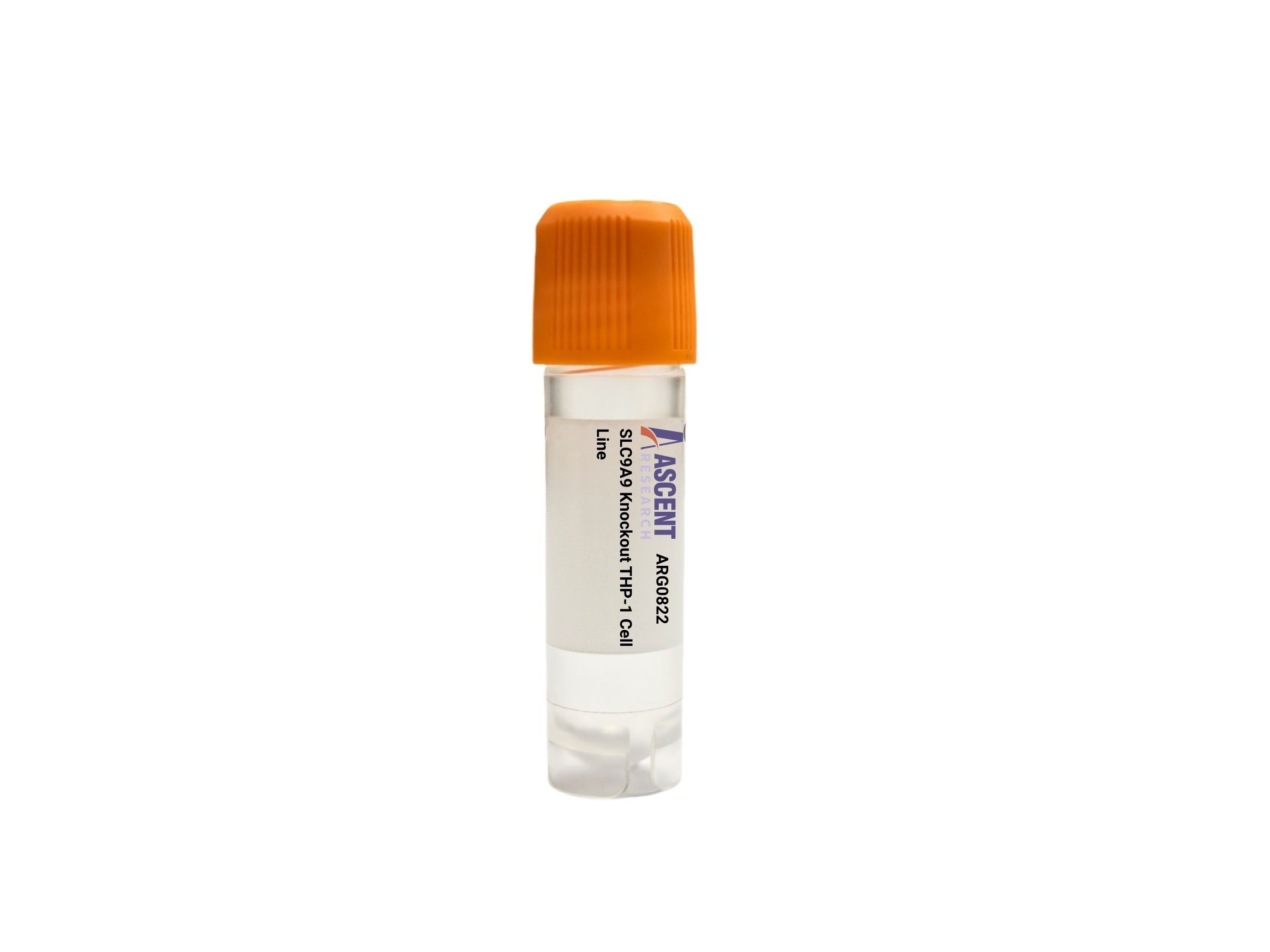
Genome-edited Cells
Blood (peripheral blood)
The SLC9A9 Knockout THP-1 Cell Line is a CRISPR/Cas9-edited knockout cell line in the THP-1 human monocytic leukemia background, designed for loss-of-function studies of the endosomal Na+/H+ exchanger NHE9. NHE9, regulated by mTORC1 and TFEB, interacts with CHP and V-ATPase to control endosomal pH, and its disruption impairs autophagy and mTORC1 signaling. This model supports research on endosomal trafficking in immune cell differentiation, pHrodo-based acidification assays, and drug screening for pH modulators. It is also relevant to SLC9A9-linked pathologies including autism spectrum disorder, ADHD, and glioblastoma. Contact Ascent Research for details.
 P4HB Knockout SK-HEP-1 Polyclonal Cells
Cat. No. ARG15209
ENDOD1 Knockout CAL27 Polyclonal Cells
Cat. No. ARG11545
HECA Knockout NCI-H1975 Polyclonal Cells
Cat. No. ARG31614
EFNA1 Knockout AGS Polyclonal Cells
Cat. No. ARG40665
DCUN1D3 Knockout MES-OV Polyclonal Cells
Cat. No. ARG5866
P4HB Knockout SK-HEP-1 Polyclonal Cells
Cat. No. ARG15209
ENDOD1 Knockout CAL27 Polyclonal Cells
Cat. No. ARG11545
HECA Knockout NCI-H1975 Polyclonal Cells
Cat. No. ARG31614
EFNA1 Knockout AGS Polyclonal Cells
Cat. No. ARG40665
DCUN1D3 Knockout MES-OV Polyclonal Cells
Cat. No. ARG5866
 Ccl20 Knockout SCC7 Cell Line
Cat. No. ARG0737
Ccl20 Knockout SCC7 Cell Line
Cat. No. ARG0737
The SLC9A9 Knockout THP-1 Cell Line is a CRISPR/Cas9-edited human monocytic cell line designed for functional analysis of the SLC9A9 gene, encoding the endosomal Na+/H+ exchanger NHE9. This validated knockout model enables loss-of-function studies of endosomal pH regulation in the THP-1 background, suitable for assays spanning immunofluorescence to transcriptomic profiling.
THP-1 is a widely used monocytic leukemia cell line derived from a 1-year-old male with acute monocytic leukemia. It serves as a robust model for monocyte-to-macrophage differentiation, innate immune signaling, and inflammatory responses, particularly upon phorbol ester-induced macrophage polarization. The line??s endosomal and autophagic pathways are highly relevant to immune cell function.
SLC9A9 encodes NHE9, an endosomal Na+/H+ exchanger that finely regulates luminal pH by exchanging luminal H+ for cytosolic Na+. NHE9 activity is controlled by upstream regulators including the nutrient-sensing mTORC1 kinase, the energy sensor AMPK, and the transcription factor TFEB. It interacts with calcineurin B homologous protein (CHP), the vacuolar ATPase (V-ATPase), and ??-arrestin within endosomal sorting complexes. By modulating endosomal acidification, NHE9 influences LC3 lipidation, EGFR recycling, and mTORC1 activation. Loss of NHE9 disrupts endosomal pH homeostasis, leading to aberrant distribution of early endosome markers such as EEA1 and Rab5, impaired Rab7-mediated maturation, and defective autophagic flux evidenced by accumulation of LC3-II and p62/SQSTM1.
In THP-1 cells, SLC9A9 knockout provides a powerful platform to dissect how endosomal pH dysregulation impacts monocyte and macrophage function. NHE9 deficiency impairs phagocytosis, alters cytokine secretion profiles, and disrupts differentiation, processes that are tightly linked to mTORC1-mediated control of autophagy and immune activation. This model is particularly valuable for exploring the molecular links between endosomal trafficking, innate immune signaling, and inflammatory responses, and for studying how endosomal dysfunction contributes to disease states such as glioblastoma and colorectal cancer, where SLC9A9 has been implicated.
Typical applications include quantitative endosomal acidification assays using pHrodo conjugates, autophagic flux monitoring via LC3 and p62 immunoblotting or immunofluorescence, cytokine profiling by ELISA, and transcriptome-wide analysis by RNA-seq. The cell line supports drug screening for compounds that modulate endosomal pH or restore autophagic clearance, and it enables functional studies of SLC9A9-associated neurodevelopmental disorders like autism spectrum disorder and ADHD. For further technical information and support, please contact Ascent Research.