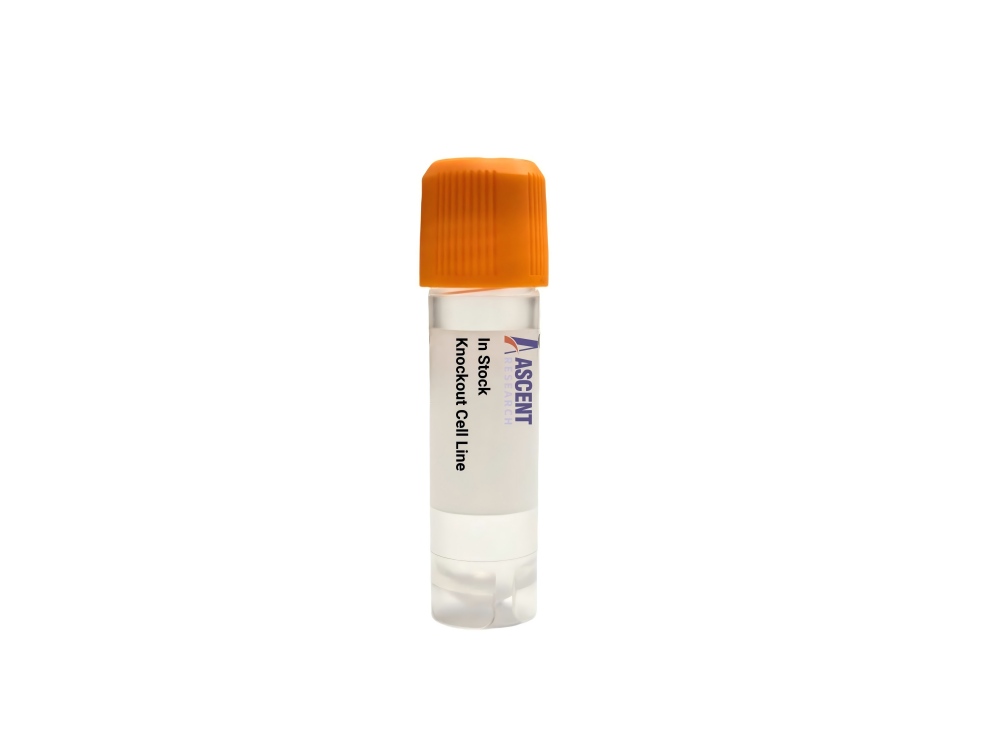
In Stock Cell Lines
Mus musculus (Mouse)
Ascites
Adherent
The Ivns1abp Knockout RAW 264.7 Cell Line is a CRISPR/Cas9-edited murine macrophage cell line with targeted disruption of the Ivns1abp gene. Ivns1abp encodes a protein that binds influenza A virus NS1 and facilitates viral mRNA nuclear export via interactions with ALYREF, UAP56/DDX39B, and NXF1. This knockout model enables dissection of host-virus interactions and antiviral innate immune pathways in a macrophage context relevant to influenza research. Applications include studying mRNA export, influenza replication mechanisms, and antiviral target validation using co-immunoprecipitation, western blotting, and plaque assays. The model enables exploration of NS1-dependent host gene modulation in macrophages.
 PHF10 Knockout SK-HEP-1 Polyclonal Cells
Cat. No. ARG15790
PALLD Knockout HT29 Polyclonal Cells
Cat. No. ARG14561
B3GAT3 Knockout Hela Polyclonal Cells
Cat. No. ARG37586
CASP1 Knockout Raji Polyclonal Cells
Cat. No. ARG42405
DNAJB2 Knockout A549 Polyclonal Cells
Cat. No. ARG39114
PHF10 Knockout SK-HEP-1 Polyclonal Cells
Cat. No. ARG15790
PALLD Knockout HT29 Polyclonal Cells
Cat. No. ARG14561
B3GAT3 Knockout Hela Polyclonal Cells
Cat. No. ARG37586
CASP1 Knockout Raji Polyclonal Cells
Cat. No. ARG42405
DNAJB2 Knockout A549 Polyclonal Cells
Cat. No. ARG39114
 Rat Renal Proximal Tubular Epithelial Cell Medium
Cat. No. ARM0267
Rat Renal Proximal Tubular Epithelial Cell Medium
Cat. No. ARM0267
The Ivns1abp Knockout RAW 264.7 Cell Line is a CRISPR/Cas9-mediated gene-disrupted macrophage cell model derived from the RAW 264.7 line. This product provides a targeted loss-of-function system for studying Ivns1abp, a gene implicated in influenza A virus replication and cellular mRNA metabolism. The knockout cell line serves as a robust platform for interrogating the molecular mechanisms by which Ivns1abp influences viral mRNA export, pre-mRNA splicing, and antiviral innate immunity.
RAW 264.7 is an Abelson murine leukemia virus-transformed macrophage cell line established from BALB/c mice. These cells retain key macrophage functions, including phagocytosis, cytokine production, and antigen presentation, making them a widely used model for innate immunity and host-pathogen interactions. The immortalized nature of RAW 264.7 cells allows for stable genetic manipulation and scalable experimental formats, while preserving physiologically relevant signaling pathways characteristic of primary macrophages.
Ivns1abp (influenza virus NS1A-binding protein) functions at the interface of viral replication and host mRNA processing. The encoded protein binds the influenza A virus NS1 protein and links viral mRNAs to the cellular mRNA export machinery, including the TREX complex components ALYREF and UAP56/DDX39B, and the export receptor NXF1. Ivns1abp also participates in host pre-mRNA splicing and is regulated by type I interferons and viral infection. It acts downstream of NS1 to promote viral mRNA export, while its modulation of host antiviral genes and interferon-stimulated genes suggests a role in shaping the innate immune response. The interaction network includes spliceosomal proteins and adaptors that couple transcription to mRNA export.
In RAW 264.7 macrophages, Ivns1abp knockout disrupts a critical node in the viral mRNA export pathway, enabling dissection of NS1-dependent manipulation of host gene expression. Given the macrophage??s central role in innate antiviral defense, this model permits evaluation of how Ivns1abp influences interferon-stimulated gene induction and cytokine production during influenza infection. The cell line provides a physiologically relevant setting to study the interplay between viral evasion strategies and macrophage-intrinsic immune responses, particularly the NS1?CIvns1abp?CALYREF?CNXF1 axis.
Researchers can employ techniques such as co-immunoprecipitation, western blotting, RT-qPCR, immunofluorescence, plaque assays, and luciferase reporter assays to investigate host-virus interactions, mRNA export dynamics, and antiviral target validation. The Ivns1abp Knockout RAW 264.7 Cell Line is an essential tool for advancing understanding of influenza replication mechanisms and for screening compounds that disrupt viral mRNA trafficking. For further details or technical assistance, please contact Ascent Research.