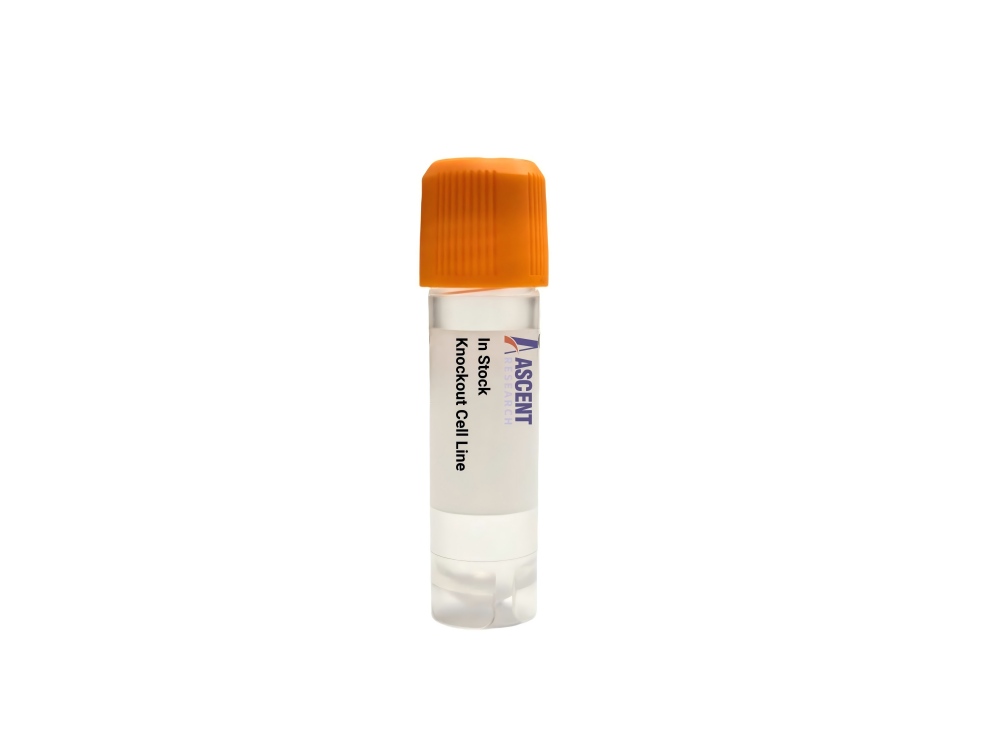
In Stock Cell Lines
Homo sapiens (Human)
Blood (peripheral blood)
Suspension
The NR1I2 Knockout THP-1 Cell Line is a CRISPR/Cas9-edited human monocytic cell line lacking the xenobiotic-sensing nuclear receptor PXR. This model enables detailed investigation of PXR-regulated drug metabolism and transport pathways, including its downstream targets CYP3A4 and MDR1, within a relevant immune cell background. THP-1 cells are widely used for monocyte/macrophage studies and can be differentiated with PMA. The knockout line is suited for drug-drug interaction assays, nuclear receptor signaling studies, and high-throughput screening of PXR agonists and antagonists. It also supports toxicology research and evaluation of chemoresistance mechanisms in macrophage-like cells. For more information, contact Ascent Research.
 CA8 Knockout HAP1 Polyclonal Cells
Cat. No. ARG37067
MTHFSD Knockout jurkat Polyclonal Cells
Cat. No. ARG13598
IL27 Knockout 786O Polyclonal Cells
Cat. No. ARG35737
PGM3 Knockout MES-OV Polyclonal Cells
Cat. No. ARG6880
CA8 Knockout HAP1 Polyclonal Cells
Cat. No. ARG37067
MTHFSD Knockout jurkat Polyclonal Cells
Cat. No. ARG13598
IL27 Knockout 786O Polyclonal Cells
Cat. No. ARG35737
PGM3 Knockout MES-OV Polyclonal Cells
Cat. No. ARG6880
 Mouse Saphenous Vein Endothelial Cell Medium
Cat. No. ARM0449
Mouse Saphenous Vein Endothelial Cell Medium
Cat. No. ARM0449
 SK-MEL-5
Cat. No. ARC0834
SK-MEL-5
Cat. No. ARC0834
The NR1I2 Knockout THP-1 Cell Line is a CRISPR/Cas9-mediated loss-of-function model designed to abolish expression of the NR1I2 gene, which encodes the xenobiotic-sensing nuclear receptor PXR. Derived from the well-characterized THP-1 human monocytic cell line, this knockout cell line serves as a powerful tool for investigating the role of PXR in drug metabolism, nuclear receptor signaling, and their interplay with immune responses.
Established from peripheral blood of a 1-year-old male with acute monocytic leukemia, THP-1 cells are a standard model for monocyte and macrophage biology. They are non-adherent in their undifferentiated state and can be differentiated into macrophage-like cells upon treatment with phorbol 12-myristate 13-acetate (PMA), thus allowing researchers to explore gene function in both monocytic and macrophage lineages. This differentiation capacity is particularly relevant for studying how PXR regulates xenobiotic detoxification in immune cells that reside in barrier tissues.
NR1I2 (PXR) is a ligand-activated nuclear receptor that heterodimerizes with retinoid X receptor alpha (RXR??) upon binding to agonists such as rifampicin, phenobarbital, SR12813, lithocholic acid, and hyperforin. The activated heterodimer binds xenobiotic response elements and upregulates genes including CYP3A4, CYP2B6, MDR1 (ABCB1), and UGT1A1, which drive phase I and phase II metabolism and drug efflux. Transcriptional activity is modulated by coactivators SRC-1 and PBP, corepressors SMRT and NCOR, and the repressor SHP. PXR also engages in crosstalk with the CAR pathway.
In THP-1 cells, NR1I2 knockout creates a unique platform to study how loss of xenobiotic sensing influences drug metabolism and immune function. Macrophages are key mediators of inflammation and frequently encounter therapeutic agents, making this model ideal for investigating PXR??s roles in drug-induced liver injury, cholestasis, inflammatory bowel disease, and chemoresistance. PMA-differentiated macrophages permit examination of PXR-dependent regulation of detoxification pathways in a mature immune cell environment.
This knockout cell line supports detailed investigations into drug metabolism, drug-drug interactions, nuclear receptor signaling, and xenobiotic response screening. Researchers can perform luciferase reporter assays, RT-qPCR for CYP3A4 and MDR1 mRNA, western blotting for CYP3A4 protein, and cell viability assays to evaluate chemosensitivity. High-throughput screening for PXR agonists and antagonists is readily implemented. For further details, contact Ascent Research.