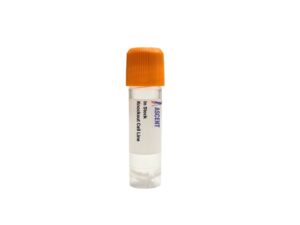
In Stock Cell Lines
The SLC5A2 Knockout HK-2 Cell Line is a CRISPR/Cas9-edited knockout cell line in the HK-2 human renal proximal tubule epithelial background, engineered to disrupt SLC5A2. This loss-of-function model eliminates the sodium/glucose cotransporter SGLT2, facilitating investigation of renal glucose reabsorption and metabolic regulation. Encoded by SLC5A2, SGLT2 functions apically, interacting with PDZK1 and inhibited clinically by empagliflozin and dapagliflozin, and its absence alters AMPK/mTORC1 signaling. The cell line is suited for glucose uptake assays, inhibitor screening, and diabetic kidney disease research.
 MECR Knockout HT29 Polyclonal Cells
Cat. No. ARG14676
MAPK4 Knockout SKOV3 Polyclonal Cells
Cat. No. ARG12368
LY96 Knockout SKOV3 Polyclonal Cells
Cat. No. ARG12358
PEPD Knockout Hela Polyclonal Cells
Cat. No. ARG8754
CPT2 Knockout Hela Polyclonal Cells
Cat. No. ARG8193
BDH1 Knockout HCT116 Polyclonal Cells
Cat. No. ARG34834
MECR Knockout HT29 Polyclonal Cells
Cat. No. ARG14676
MAPK4 Knockout SKOV3 Polyclonal Cells
Cat. No. ARG12368
LY96 Knockout SKOV3 Polyclonal Cells
Cat. No. ARG12358
PEPD Knockout Hela Polyclonal Cells
Cat. No. ARG8754
CPT2 Knockout Hela Polyclonal Cells
Cat. No. ARG8193
BDH1 Knockout HCT116 Polyclonal Cells
Cat. No. ARG34834
The SLC5A2 Knockout HK-2 Cell Line is a CRISPR/Cas9-edited knockout cell line with targeted disruption of the SLC5A2 gene in the HK-2 human renal proximal tubule epithelial cell line. This loss-of-function model eliminates endogenous SGLT2 expression, providing a clean system to investigate sodium/glucose cotransporter 2 function. The cell line is delivered as a live culture, ready for experimental application.
HK-2 cells are immortalized human proximal tubule epithelial cells derived from normal adult kidney cortex. They retain key attributes of the proximal tubule, including reabsorption of glucose, amino acids, and solutes from the glomerular filtrate, and participate in electrolyte and volume homeostasis. Widely used in nephrotoxicity testing and transporter research, HK-2 cells serve as a physiologically relevant host for studying SLC5A2 biology.
The SLC5A2 gene encodes SGLT2, the apical high-capacity transporter responsible for the majority of renal glucose reabsorption by coupling glucose influx to the sodium electrochemical gradient. Transcription is controlled by HNF1A and HNF4A, and activity is modulated by insulin and extracellular glucose levels. SGLT2 functions within a network that includes the basolateral glucose uniporter GLUT2 (SLC2A2) and the Na?/K?-ATPase (ATP1A1), and interacts with scaffold proteins PDZK1, PDZK1IP1 (MAP17), and SLC9A3R1 (NHERF1). Pharmacologic inhibitors empagliflozin and dapagliflozin block SGLT2. Gene disruption eliminates SGLT2-mediated glucose uptake, reducing intracellular glucose and altering glycolytic flux, AMPK, and mTORC1 signaling, recapitulating SGLT2 inhibition and familial renal glucosuria mutations.
In the HK-2 cellular environment, SLC5A2 knockout creates a definitive model to study SGLT2-dependent transport and metabolic signaling. The absence of SGLT2 allows precise measurement of sodium-dependent glucose uptake and dissection of downstream metabolic effects, it is an invaluable tool for investigating diabetic kidney disease progression and evaluating SGLT2 inhibitor pharmacology.
The cell line supports a broad range of experimental applications, including high-throughput screening of SGLT2 inhibitors, transporter trafficking studies, and functional glucose uptake assays using 2-NBDG or radiolabeled ??-methyl-D-glucopyranoside. It is compatible with western blotting, RT-qPCR, immunofluorescence, and dose-response analyses with empagliflozin or dapagliflozin. Metabolic flux analysis via Seahorse and phospho-signaling profiling of AMPK and mTOR further characterize metabolic changes. For additional details or technical assistance, please contact Ascent Research.