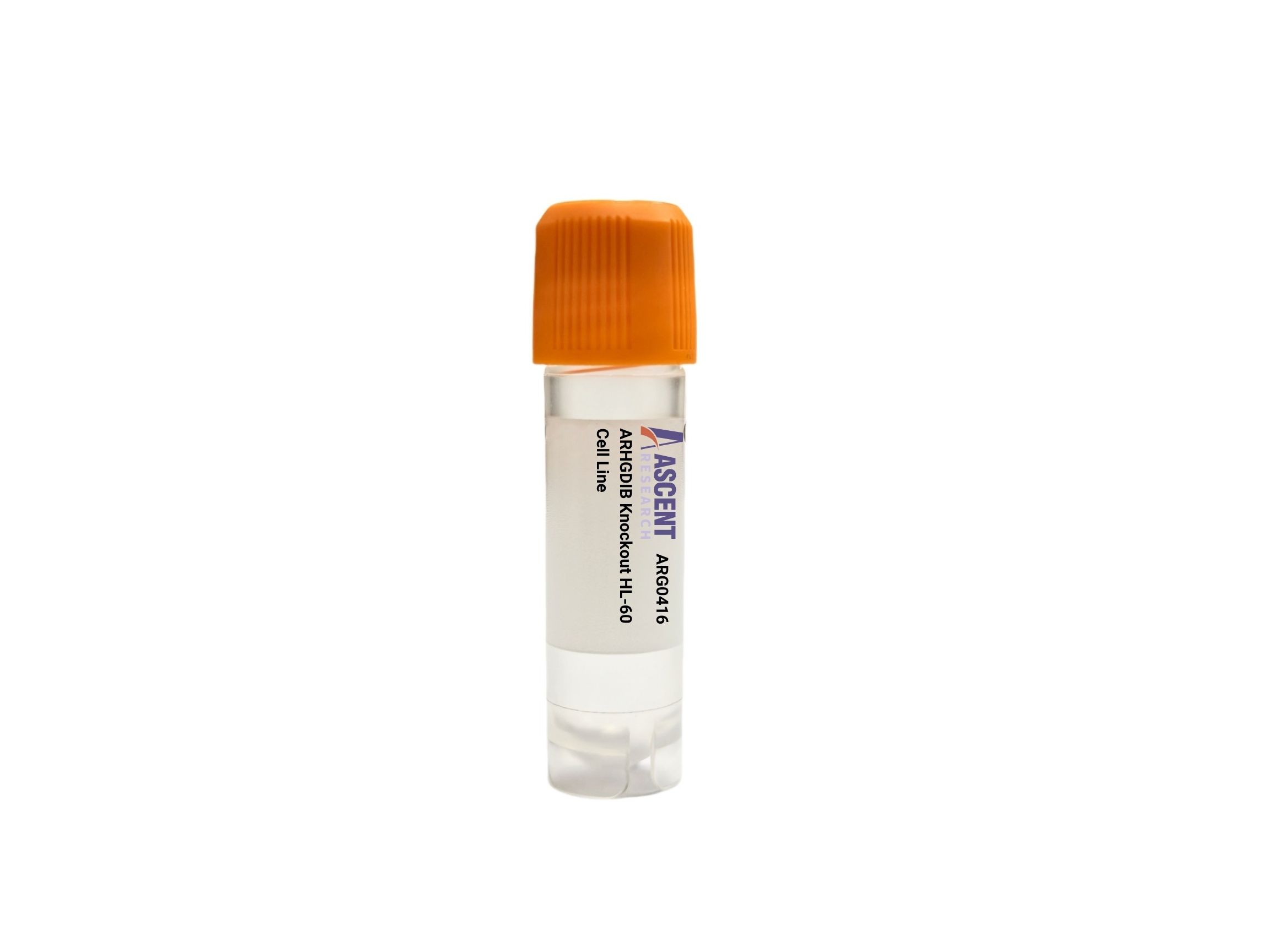
Genome-edited Cells
Blood (peripheral blood)
The ARHGDIB Knockout HL-60 Cell Line is a CRISPR/Cas9-edited human promyelocytic leukemia model lacking RhoGDI2 expression. In HL-60 cells, which were derived from acute promyelocytic leukemia and can differentiate into granulocytes and monocytes, this knockout enables study of Rho GTPase-mediated signaling and myeloid cell function. Loss of RhoGDI2 leads to constitutive activation of RhoA, Rac1, and Cdc42, deregulating actin dynamics, migration, and adhesion. This model is ideal for investigating leukemia cell invasiveness, differentiation blockade, and the molecular basis of immune deficiencies linked to ARHGDIB.
 CLPB Knockout A2780 Polyclonal Cells
Cat. No. ARG18351
NID1 Knockout Hela Polyclonal Cells
Cat. No. ARG8860
AP4S1 Knockout HGC-27 Polyclonal Cells
Cat. No. ARG29552
LEPROT Knockout HEK293T Polyclonal Cells
Cat. No. ARG3313
MICAL3 Knockout HEK293T Polyclonal Cells
Cat. No. ARG3280
ENTPD5 Knockout Raji Polyclonal Cells
Cat. No. ARG0982
CLPB Knockout A2780 Polyclonal Cells
Cat. No. ARG18351
NID1 Knockout Hela Polyclonal Cells
Cat. No. ARG8860
AP4S1 Knockout HGC-27 Polyclonal Cells
Cat. No. ARG29552
LEPROT Knockout HEK293T Polyclonal Cells
Cat. No. ARG3313
MICAL3 Knockout HEK293T Polyclonal Cells
Cat. No. ARG3280
ENTPD5 Knockout Raji Polyclonal Cells
Cat. No. ARG0982
The ARHGDIB Knockout HL-60 Cell Line is a CRISPR/Cas9-edited human cell line engineered to disrupt the ARHGDIB gene, leading to loss of Rho GDP dissociation inhibitor beta (RhoGDI2) protein expression. This stable knockout model enables detailed investigation of Rho GTPase signalling pathways in a human promyelocytic leukemia background. Supplied as a ready-to-use culture, it is suitable for functional genomics, signal transduction analyses, and differentiation studies without the need for additional genetic manipulation.
The HL-60 host cell line was established from the peripheral blood of a patient with acute promyelocytic leukemia and has since become a classic model for myeloid differentiation research. Upon treatment with agents such as dimethyl sulfoxide, retinoic acid, or phorbol 12-myristate 13-acetate, HL-60 cells differentiate into granulocyte- or monocyte-like cells, recapitulating key aspects of hematopoietic lineage commitment. Their well-characterized promyelocytic morphology and myeloid marker expression make them an invaluable tool for studying leukemogenesis, immune cell function, and the molecular mechanisms controlling cell fate.
ARHGDIB encodes RhoGDI2, a critical inhibitor of Rho GTPases (RhoA, Rac1, Cdc42) that sequesters them in the cytosol by blocking GDP dissociation. Phosphorylation by PAK1, Src kinase, or PKA modulates RhoGDI2?CGTPase affinity, enabling signal-induced release. Knockout leads to constitutive activation of RhoA, Rac1, and Cdc42, which hyperstimulate effectors including ROCK, PAK, LIMK, cofilin, and the Arp2/3 complex, thereby driving actin remodeling, migration, and adhesion. RhoGDI2 also interacts with ERM proteins (ezrin, radixin, moesin), linking GTPase activity to membrane?Ccytoskeleton coupling.
In HL-60 cells, ARHGDIB knockout leads to hyperactivation of Rho GTPases, promoting a hypermigratory and invasive phenotype that mirrors leukemic dissemination. The loss of RhoGDI2 also impedes granulocytic and monocytic differentiation, providing a system to study differentiation arrest. As ARHGDIB mutations underlie certain severe combined immunodeficiencies with neutrophil dysfunction, this line enables investigation of RhoGDI2 in immune cell function.
Researchers can employ this knockout line in G-LISA or pull-down assays for active RhoA, Rac1, and Cdc42; Transwell migration and invasion assays; flow cytometry for CD11b and NBT reduction tests to monitor differentiation; and Western blotting/immunofluorescence for actin cytoskeletal analysis. It is ideal for drug discovery screens targeting Rho pathways, studies of leukemic stem cell dynamics, and functional analysis of ARHGDIB in immune cells. For further details, contact Ascent Research.