Genome-edited Cells
Blood (peripheral blood)
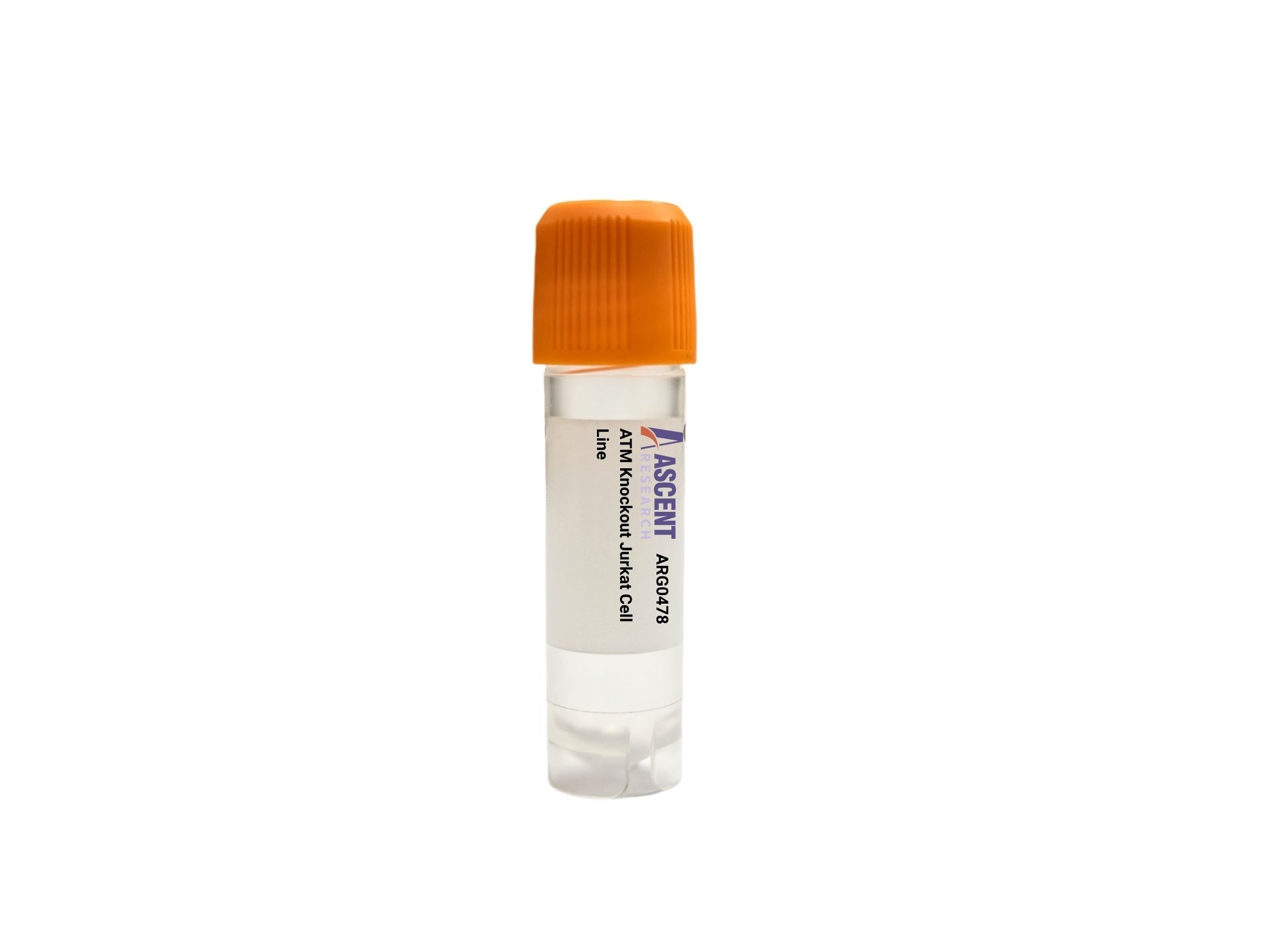
The ATM Knockout Jurkat Cell Line is a CRISPR/Cas9-edited knockout cell line lacking functional ATM serine/threonine kinase, a master regulator of the DNA damage response. Derived from the Jurkat T-lymphocyte leukemia line, this model enables investigation of ATM-dependent signaling in a T-cell context, with specific impairment of DNA damage-induced phosphorylation events. ATM is activated by DNA double-strand breaks and phosphorylates key substrates such as p53 and CHK2 to control cell cycle arrest, DNA repair, and apoptosis. This cell line supports applications in DNA damage studies, cancer drug sensitivity screening, and immunology research, and serves as a relevant system for studying ataxia-telangiectasia and T-cell leukemia biology. Representative assays include Western blotting for ATM and ??-H2AX, flow cytometry, and drug sensitivity testing.
The ATM Knockout Jurkat Cell Line is a CRISPR/Cas9-edited knockout cell line derived from the Jurkat human T-lymphocyte leukemia line. This product features targeted disruption of the ATM (ataxia-telangiectasia mutated) gene, which encodes a serine/threonine kinase pivotal for DNA damage signaling. CRISPR/Cas9-mediated gene disruption establishes a loss-of-function model suitable for functional studies. This cell line provides a well-defined genetic background to investigate ATM-dependent signaling pathways in a T-cell context.
The parental Jurkat cell line is a widely used human T-lymphocyte leukemia model established from the peripheral blood of a 14-year-old patient with acute T-cell leukemia. Jurkat cells are suspension-adapted and retain many features of T lymphocytes, making them a standard platform for studying T-cell receptor signaling, immune responses, and hematological malignancies. Their rapid proliferation and well-characterized biology facilitate genetic manipulation and downstream phenotypic analyses.
ATM kinase serves as a primary transducer of DNA double-strand break (DSB) signals, becoming activated by the MRE11-RAD50-NBS1 (MRN) sensor complex and oxidative stress. Once activated, ATM phosphorylates a broad array of downstream effectors, including p53 (TP53), CHK2 (CHEK2), histone variant H2AX (??-H2AX), BRCA1, c-Abl (ABL1), SMC1, MDM2, and the IKK complex. These phosphorylation events orchestrate cell cycle arrest, facilitate DNA repair via non-homologous end joining and homologous recombination, and trigger apoptosis when damage is irreparable. ATM also interacts with ATR, DNA-PKcs (PRKDC), and CtIP (RBBP8) to coordinate the cellular response to genotoxic stress. Key pathway components include p21 (CDKN1A) and GADD45 downstream of p53, further enforcing cell cycle checkpoints.
In Jurkat T cells, ATM knockout profoundly compromises the DNA damage response, leading to delayed or absent phosphorylation of critical substrates such as p53, CHK2, and H2AX upon exposure to ionizing radiation or radiomimetic agents. This deficit results in impaired cell cycle checkpoint activation, increased genomic instability, and altered apoptotic thresholds. Consequently, the ATM knockout Jurkat cell line offers a valuable tool to dissect the role of ATM in lymphocyte biology and its contribution to lymphoid malignancies. The model is particularly relevant for studying ataxia-telangiectasia, a primary immunodeficiency and cancer predisposition syndrome caused by ATM mutations, as well as for exploring mechanisms of chemoresistance in T-cell leukemias and lymphomas.
This cell line is ideally suited for a range of research applications, including DNA damage response studies, cancer drug sensitivity screening, and immunology research. Representative experimental approaches include Western blotting for ATM, phospho-p53, and ??-H2AX; flow cytometry-based cell cycle and apoptosis analyses; immunofluorescence detection of ??-H2AX foci; drug sensitivity assays using etoposide or ionizing radiation; RT-qPCR quantification of p53 target genes; and comet assays to assess DNA strand breaks. The ATM knockout Jurkat cell line enables systematic investigation of ATM-mediated signaling and its impact on T-cell function and leukemogenesis. For additional product details or technical support, please contact Ascent Research.