Genome-edited Cells
Uterus (cervix)
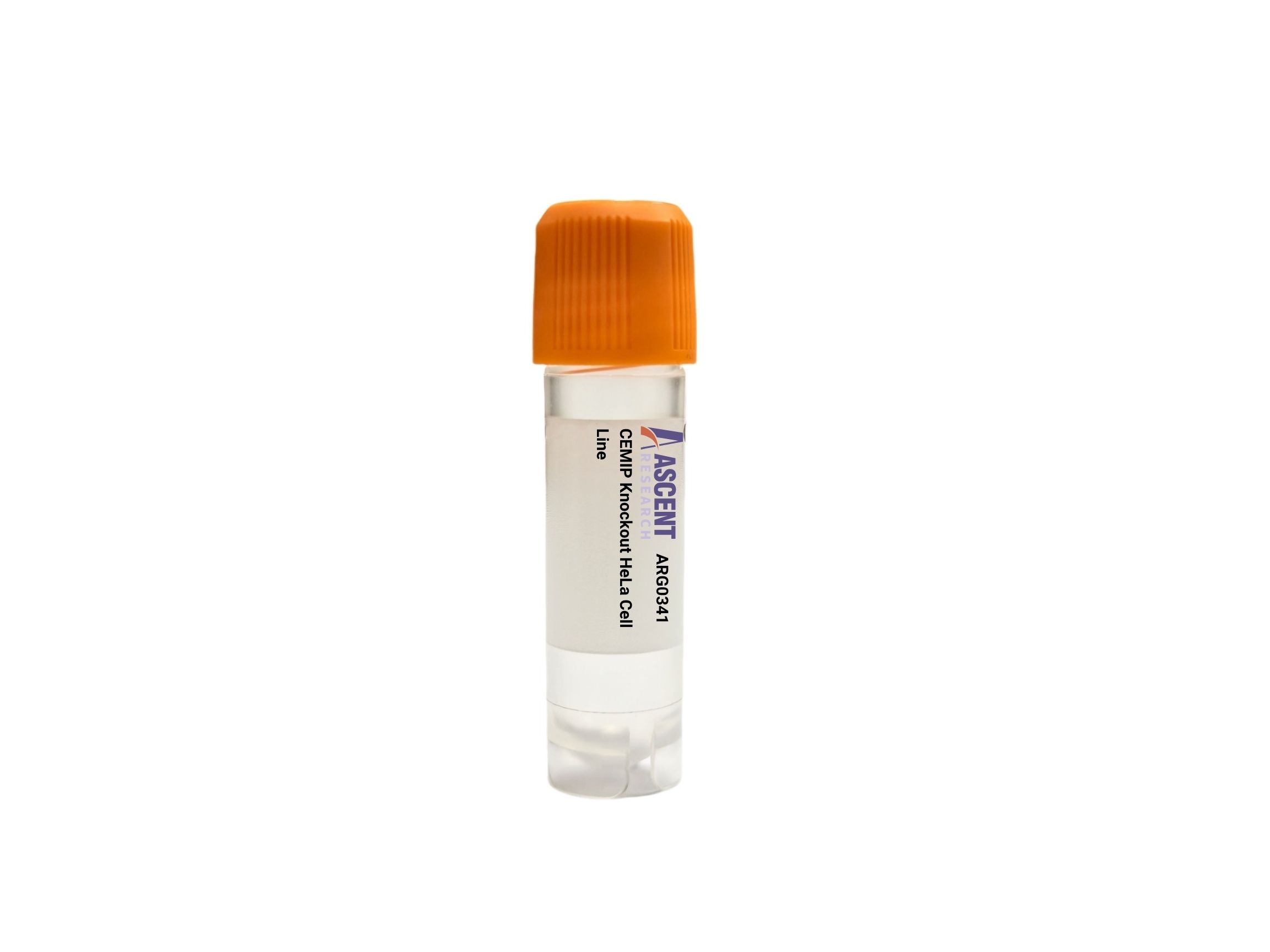
The CEMIP Knockout HeLa Cell Line is a CRISPR/Cas9-edited human cell line derived from HeLa cervical adenocarcinoma cells, providing a targeted loss-of-function model for CEMIP, which encodes a hyaluronan-depolymerizing protein that promotes cell migration, extracellular matrix remodeling, and tumor progression. CEMIP signaling activates CD44, EGFR, and downstream ERK/AKT/??-catenin pathways, increasing expression of pro-invasive factors such as MMP9 and Snail. This knockout cell line is suitable for studying hyaluronan-mediated metastatic mechanisms, performing cell invasion assays, and screening anti-metastatic compounds.
 CAMSAP1 Knockout A2780 Polyclonal Cells
Cat. No. ARG28989
PDCD4 Knockout NCI-H1975 Polyclonal Cells
Cat. No. ARG16717
CFAP36 Knockout Hela Polyclonal Cells
Cat. No. ARG8107
ABTB2 Knockout NCI-H1975 Polyclonal Cells
Cat. No. ARG31022
IDH2 Knockout Lovo Polyclonal Cells
Cat. No. ARG36379
CYBRD1 Knockout HEK293T Polyclonal Cells
Cat. No. ARG4498
CAMSAP1 Knockout A2780 Polyclonal Cells
Cat. No. ARG28989
PDCD4 Knockout NCI-H1975 Polyclonal Cells
Cat. No. ARG16717
CFAP36 Knockout Hela Polyclonal Cells
Cat. No. ARG8107
ABTB2 Knockout NCI-H1975 Polyclonal Cells
Cat. No. ARG31022
IDH2 Knockout Lovo Polyclonal Cells
Cat. No. ARG36379
CYBRD1 Knockout HEK293T Polyclonal Cells
Cat. No. ARG4498
The CEMIP Knockout HeLa Cell Line is a CRISPR/Cas9-edited human cell line with targeted disruption of the CEMIP (KIAA1199) gene. Derived from HeLa cervical adenocarcinoma cells, this loss-of-function model enables precise investigation of CEMIP-mediated hyaluronan metabolism, cell migration, and extracellular matrix remodeling. It provides a stable system for functional assays and can be integrated into drug discovery and signaling research workflows.
HeLa cells, an immortalized epithelial cell line from a human cervical adenocarcinoma, are widely used in cancer biology and signal transduction studies. Their robust proliferation and tumorigenic properties make them a valuable model for cervical cancer progression. Disruption of CEMIP in this genetic background allows dissection of hyaluronan signaling contributions to the malignant phenotype.
CEMIP functions as a hyaluronidase that depolymerizes high-molecular-weight hyaluronan into pro-inflammatory fragments. These fragments bind CD44 and TLR4, transactivate EGFR, and initiate downstream cascades. CEMIP is regulated by TGF-??, TNF-??, IL-1??, HIF-1??, and NF-??B. Signaling through CEMIP promotes phosphorylation of ERK1/2 and AKT, stabilizes ??-catenin, and upregulates MMP2, MMP9, and Snail. Interacting partners clathrin and HSP90 modulate its activity. This network integrates EGFR, Wnt/??-catenin, NF-??B, and calcium pathways to drive cell migration and invasion.
In HeLa cells, CEMIP sustains an invasive phenotype via hyaluronan catabolism and receptor activation. The CEMIP knockout line is essential for studying EGFR transactivation, ??-catenin nuclear translocation, and MMP-dependent matrix degradation in cervical adenocarcinoma. This model is valuable for examining the interplay between extracellular matrix dynamics and oncogenic signaling, providing a platform for testing anti-metastatic therapies targeting hyaluronan-mediated pathways.
Applications include cancer metastasis research, hyaluronan signaling studies, and anti-metastatic drug screening. Assays such as western blotting for CEMIP, phospho-ERK, and AKT; RT-qPCR for MMP9 and Snail; hyaluronan degradation assays; scratch wound and Boyden chamber invasion assays; immunofluorescence and co-immunoprecipitation for CD44/EGFR; and flow cytometry for CD44 are routinely employed. For further information, contact Ascent Research.