Genome-edited Cells
Kidney
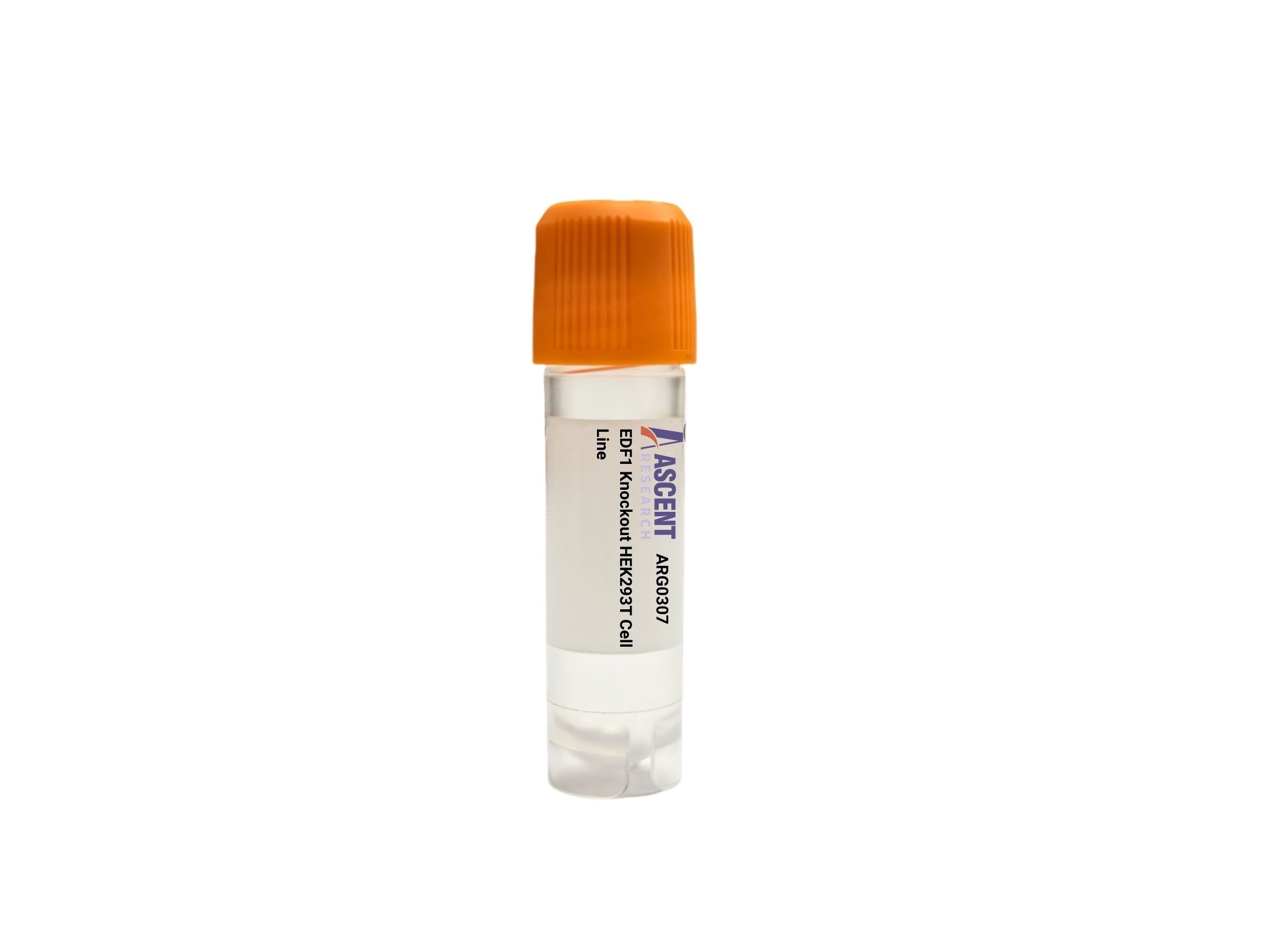
The EDF1 Knockout HEK293T Cell Line is a CRISPR/Cas9-edited human embryonic kidney cell line with targeted disruption of the EDF1 gene. EDF1 functions as a transcriptional coactivator that interacts with PPAR?? and TBP to regulate lipid metabolism and endothelial differentiation. Its activity is modulated by VEGF and hypoxia, and it promotes expression of key effectors such as CD36 and PLIN2. This knockout model enables dissection of PPAR?? coactivation, rescue experiments, and nuclear receptor modulator screening. Compatible assays include western blotting, qPCR, luciferase reporters, and co-immunoprecipitation.
 LY96 Knockout A2780 Polyclonal Cells
Cat. No. ARG18415
JADE3 Knockout HEK293T Polyclonal Cells
Cat. No. ARG38022
CHSY1 Knockout HCT116 Polyclonal Cells
Cat. No. ARG7132
MOCS2 Knockout HEK293T Polyclonal Cells
Cat. No. ARG3751
CRPPA Knockout HEK293T Polyclonal Cells
Cat. No. ARG3302
LY96 Knockout A2780 Polyclonal Cells
Cat. No. ARG18415
JADE3 Knockout HEK293T Polyclonal Cells
Cat. No. ARG38022
CHSY1 Knockout HCT116 Polyclonal Cells
Cat. No. ARG7132
MOCS2 Knockout HEK293T Polyclonal Cells
Cat. No. ARG3751
CRPPA Knockout HEK293T Polyclonal Cells
Cat. No. ARG3302
 HCT 8 Luciferase Stable Cell Line
Cat. No. ARG0287
HCT 8 Luciferase Stable Cell Line
Cat. No. ARG0287
The EDF1 Knockout HEK293T Cell Line is a CRISPR/Cas9-edited human cell model with targeted disruption of the EDF1 gene. Derived from HEK293T, it provides a stable knockout background for functional studies of endothelial differentiation-related factor 1. The cell line is offered as a verified, cryopreserved stock suitable for immediate culture.
HEK293T cells originate from human embryonic kidney epithelium and express the SV40 large T antigen, facilitating high-level transient protein expression and virus production. Their robust growth and high transfection efficiency make them a workhorse for molecular cell biology. These properties ensure reliable experimental consistency and compatibility with a wide range of plasmid-based assays.
EDF1 is a transcriptional coactivator that partners with PPAR?? and TBP to drive the expression of genes controlling lipid metabolism and endothelial differentiation. Upstream regulators include VEGF and hypoxia, while downstream targets encompass CD36, PLIN2, and eNOS. EDF1 also interacts with LXR, highlighting its integrative role in nuclear receptor signaling. The core PPAR?èCRXRA?CEDF1 complex orchestrates metabolic and angiogenic transcriptional programs. In the absence of EDF1, PPAR??-mediated transcription is significantly diminished, providing a clear phenotype to study coactivator function.
Since HEK293T cells lack endogenous endothelial or adipocyte differentiation programs, EDF1 knockout allows the study of its coactivation function in a neutral transcriptional environment. The line facilitates rescue experiments and dissection of PPAR?? pharmacology without confounding lineage-specific effects. Its transfection proficiency supports reporter assays and gain-of-function studies, enabling precise mapping of EDF1 domain requirements.
Typical applications include western blotting and RT-qPCR to validate knockout and monitor PPAR?? target gene expression, luciferase reporter assays to quantify transcriptional output, and co-immunoprecipitation to examine disrupted protein complexes. The line is also suitable for lipid staining and RNA-seq to characterize broader metabolic changes. It serves as a screening platform for nuclear receptor modulators. For further inquiries, please contact Ascent Research.