Genome-edited Cells
Stomach
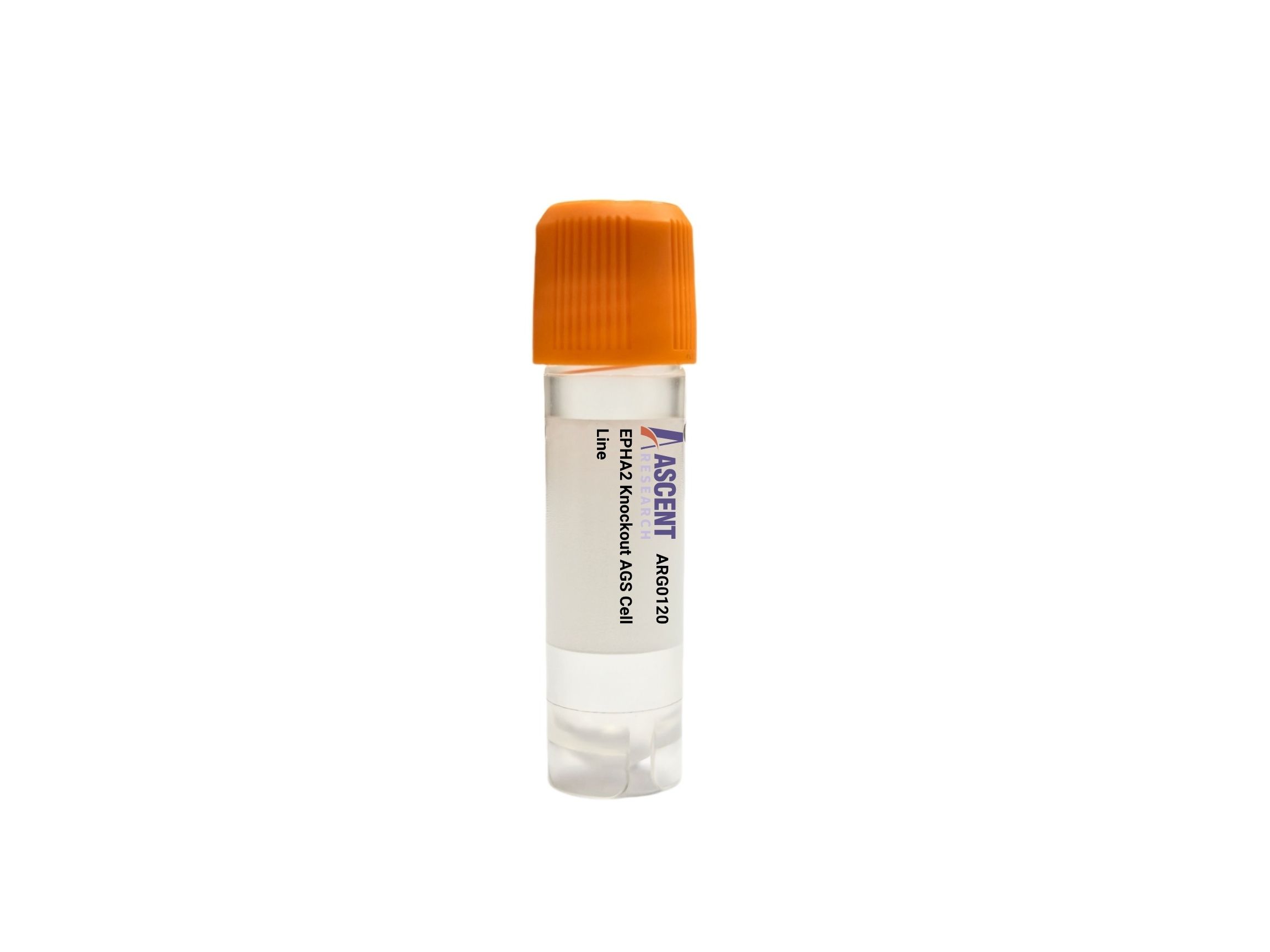
EPHA2 Knockout AGS is a CRISPR/Cas9-engineered human gastric adenocarcinoma epithelial cell line with disruption of the EPHA2 receptor tyrosine kinase gene. In AGS cells, EPHA2 is relevant to gastric epithelial signaling, adhesion, migration, and Helicobacter pylori response biology. EPHA2 is activated by ephrin ligands such as EFNA1 and interfaces with EGFR, SRC, PI3K-AKT, MAPK-ERK, and FAK/RHO GTPase signaling networks that regulate cytoskeletal organization and invasive behavior. This model is suited for gastric cancer signaling studies, phospho-signaling analysis, EMT-related phenotyping, migration and invasion assays, and targeted therapy response experiments.
The EPHA2 Knockout AGS Cell Line is a CRISPR/Cas9-engineered human cell model in which the EPHA2 gene has been disrupted to eliminate functional EPHA2 expression. This stable knockout line is generated in AGS cells, a human gastric adenocarcinoma-derived epithelial cell line, and provides an in vitro system for investigating EPHA2-dependent signaling and phenotype in a gastric epithelial tumor context. The model is designed for mechanistic studies requiring controlled loss of receptor tyrosine kinase function in cancer-associated epithelial biology.
AGS cells are widely used as a gastric mucosal tumor model because they retain strong relevance to epithelial signaling, adhesion, migration, and host-pathogen interactions. Derived from human gastric adenocarcinoma, AGS cells support studies of gastric cancer biology, growth factor receptor networks, epithelial organization, and responses to Helicobacter pylori. Their utility in analyzing receptor-driven signaling, cytoskeletal regulation, and disease-associated epithelial plasticity makes them a well-established background for evaluating genetic perturbations that influence tumor progression, dysplasia, invasion, and therapy response.
EPHA2 encodes an Eph family receptor tyrosine kinase that is activated primarily by ephrin-A ligands such as EFNA1 and EFNA3. Ligand-dependent receptor clustering promotes EPHA2 phosphorylation and regulation of cell-cell communication, adhesion dynamics, and actin cytoskeleton remodeling. In epithelial cancer systems, EPHA2 also interfaces with EGFR and ERBB2 signaling and is regulated by SRC family kinases and cell-cell contact. Downstream, EPHA2 modulates signaling nodes including AKT, ERK1/2, SRC, and PTK2/FAK, as well as RHOA, RAC1, and CDC42, with consequent effects on paxillin-associated focal adhesion signaling, migration, proliferation, and epithelial organization. Through interactions with factors such as GRB2, SHC1, NCK1, VAV2, PIK3R1, and EPHB family receptors, EPHA2 is positioned at the intersection of Ephrin-Eph signaling, PI3K-AKT, MAPK-ERK, focal adhesion signaling, and epithelial-mesenchymal transition-related processes.
Loss of EPHA2 in AGS cells is therefore a useful system for dissecting how receptor tyrosine kinase crosstalk shapes gastric epithelial tumor phenotypes. In this host-cell background, EPHA2 deletion can support analysis of altered adhesion, polarity, migration, invasive behavior, phospho-signaling states, and context-dependent responses to EGFR-linked or SRC-linked pathway activation. The model is also relevant for studying mechanisms associated with gastric cancer progression, Helicobacter pylori-associated gastric disease, metastasis and invasion, and pathway dependencies connected to therapy resistance research.
This knockout cell line can be applied in western blot and phospho-signaling studies to compare AKT, ERK1/2, SRC, or FAK/PTK2 pathway activity between EPHA2-deficient and control cells. It is suitable for RT-qPCR and RNA-seq experiments examining transcriptional consequences of receptor loss, including changes linked to adhesion, EMT-related programs, or receptor network compensation. Immunofluorescence and flow cytometry may be used to assess epithelial architecture, surface receptor expression, or cytoskeletal organization, while co-immunoprecipitation can support analysis of altered interactions among EPHA2-associated signaling components such as EGFR, ERBB2, SRC, and adaptor proteins. Functional studies may include migration, invasion, proliferation, apoptosis, colony formation, and drug sensitivity assays to define EPHA2-dependent phenotypes in gastric cancer and host-pathogen interaction settings. Researchers may contact Ascent Research for additional technical information, product details, or related gene-edited cell models.