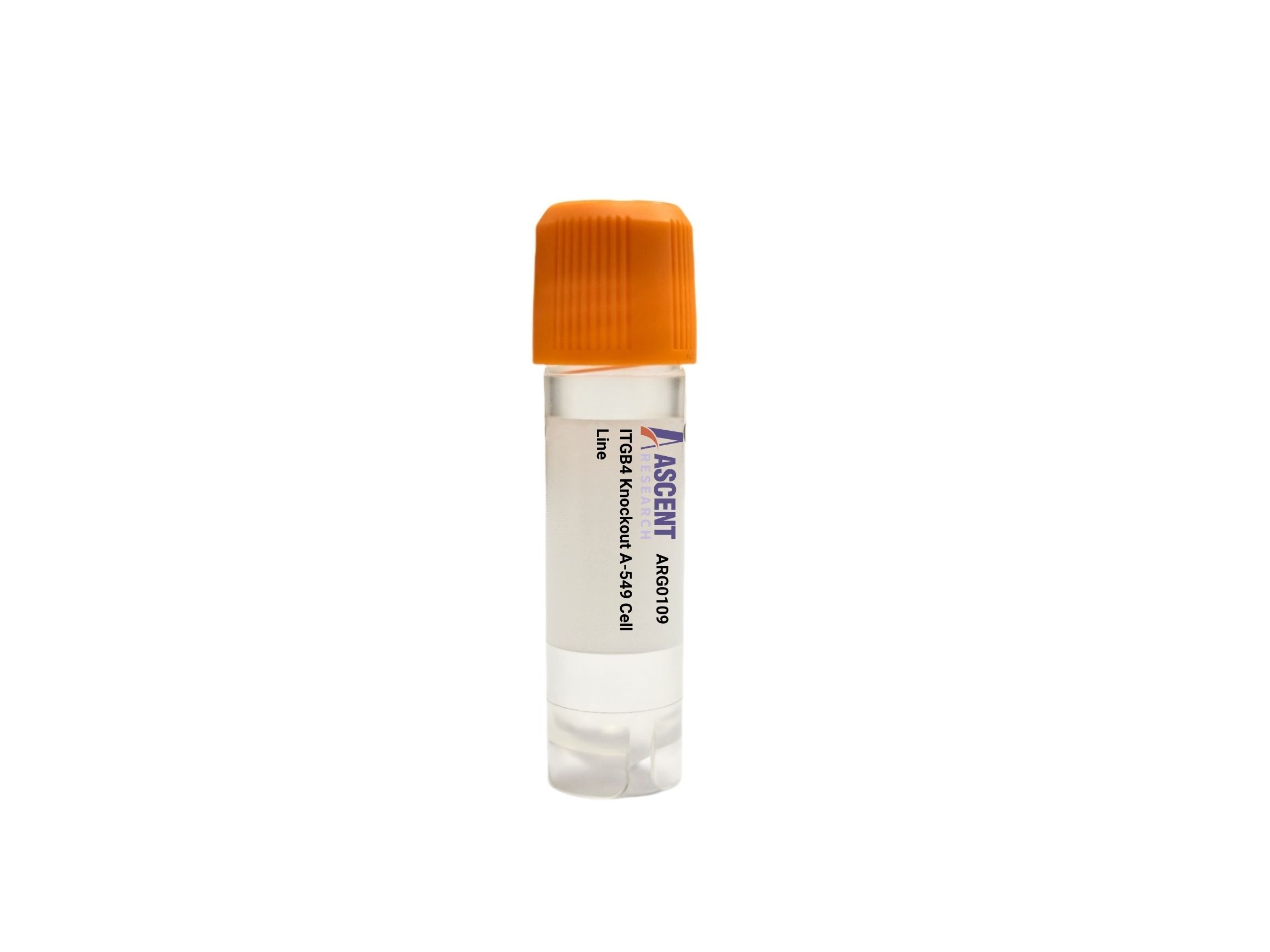
Genome-edited Cells
Lung
The ITGB4 Knockout A-549 Cell Line is a CRISPR/Cas9-engineered human lung adenocarcinoma epithelial model with disruption of integrin beta-4 in an alveolar epithelial-like NSCLC background. ITGB4 normally pairs with ITGA6 to form the alpha6beta4 laminin receptor and interacts with laminin-332, plectin, FAK, SRC, and PI3K to regulate hemidesmosome organization, adhesion-dependent survival, migration, and invasion. This knockout model is useful for studying laminin-cell adhesion, PI3K-AKT and FAK-SRC signaling, epithelial motility, and drug response using western blotting, immunofluorescence, adhesion assays, migration/invasion assays, RNA-seq, and inhibitor sensitivity studies.
 CDYL Knockout Hela Polyclonal Cells
Cat. No. ARG8254
ALKBH6 Knockout HAP1 Polyclonal Cells
Cat. No. ARG21781
IGFBPL1 Knockout HAP1 Polyclonal Cells
Cat. No. ARG22726
AR Knockout Jurkat Polyclonal Cells
Cat. No. ARG23341
BCL7B Knockout HEK293T Polyclonal Cells
Cat. No. ARG25827
CDYL Knockout Hela Polyclonal Cells
Cat. No. ARG8254
ALKBH6 Knockout HAP1 Polyclonal Cells
Cat. No. ARG21781
IGFBPL1 Knockout HAP1 Polyclonal Cells
Cat. No. ARG22726
AR Knockout Jurkat Polyclonal Cells
Cat. No. ARG23341
BCL7B Knockout HEK293T Polyclonal Cells
Cat. No. ARG25827
 Rabbit Corneal Epithelial Cells
Cat. No. ARP0872
Rabbit Corneal Epithelial Cells
Cat. No. ARP0872
The ITGB4 Knockout A-549 Cell Line is a human gene-edited in vitro model generated by CRISPR/Cas9-mediated disruption of the ITGB4 locus in A-549 cells, resulting in loss of functional integrin beta-4 expression. This stable knockout line is designed for studies requiring targeted interrogation of integrin-dependent epithelial adhesion and signaling. The parental A-549 background is a human lung adenocarcinoma epithelial cell line with alveolar epithelial-like features, providing a relevant context for investigation of tumor-associated adhesion mechanisms, matrix signaling, and epithelial cell behavior.
A-549 cells are widely used as a model of non-small cell lung cancer and alveolar type II-like epithelial biology because they retain epithelial morphology and support experimental analysis of cell-matrix interactions, oncogenic signaling, and drug response. As lung adenocarcinoma-derived cells, they are particularly useful for examining processes linked to epithelial organization, survival under matrix-dependent conditions, migratory plasticity, and carcinoma progression. Their extensive use in molecular and cellular oncology makes this host line a practical system for comparative signaling studies, phenotypic assays, and pathway-focused perturbation experiments.
ITGB4 encodes integrin beta-4, which pairs with ITGA6 to form the laminin receptor alpha6beta4. This receptor binds extracellular matrix ligands including laminin-332 and laminin-511 and forms complexes with structural hemidesmosomal factors such as plectin, collagen XVII (COL17A1), and BP230 dystonin. In epithelial cells, alpha6beta4 links matrix attachment to cytoskeletal organization and mediates signaling downstream of epithelial matrix engagement. ITGB4 function is regulated by upstream inputs including EGFR, HGF-MET signaling, PKC activation, SRC family kinases, and phosphoinositide signaling. Downstream, ITGB4-associated complexes modulate phosphorylation of PTK2/FAK, SRC, and AKT, influence MAPK1/MAPK3 (ERK1/2) activation, and affect RAC1 and RHOA-dependent control of migration, invasion, and survival signaling output. These pathways are directly relevant to lung cancer progression, epithelial carcinoma invasion, and other adhesion-associated disease settings.
Within the A-549 background, ITGB4 loss provides a focused system to examine how disruption of laminin-dependent anchorage alters signaling networks and epithelial tumor cell phenotypes. This model is well suited for studies of hemidesmosome organization, focal adhesion dynamics, extracellular matrix dependency, and crosstalk between integrin signaling and receptor tyrosine kinase pathways such as EGFR. It may also support investigation of how ITGB4 deficiency reshapes PI3K-AKT, FAK-SRC, and MAPK-ERK pathway activity in relation to cell survival, motility, and invasion-associated gene expression.
Researchers can apply this knockout line in western blot or phospho-signaling workflows to measure AKT, FAK, SRC, and ERK1/2 responses following laminin stimulation, growth factor treatment, or inhibitor exposure. RT-qPCR and RNA-seq can be used to profile transcriptional changes associated with adhesion loss and invasion programs. Immunofluorescence, flow cytometry, and co-immunoprecipitation enable analysis of ITGA6-associated complexes, plectin recruitment, and cell-surface receptor organization. Functional studies may include cell adhesion assays on laminin-rich substrates, migration and invasion assays, apoptosis measurements under altered matrix conditions, colony formation assays, and drug sensitivity studies involving EGFR or PI3K pathway inhibitors. Researchers may contact Ascent Research for additional technical information, product details, or related gene-edited cell models.