Genome-edited Cells
Large intestine (colon)
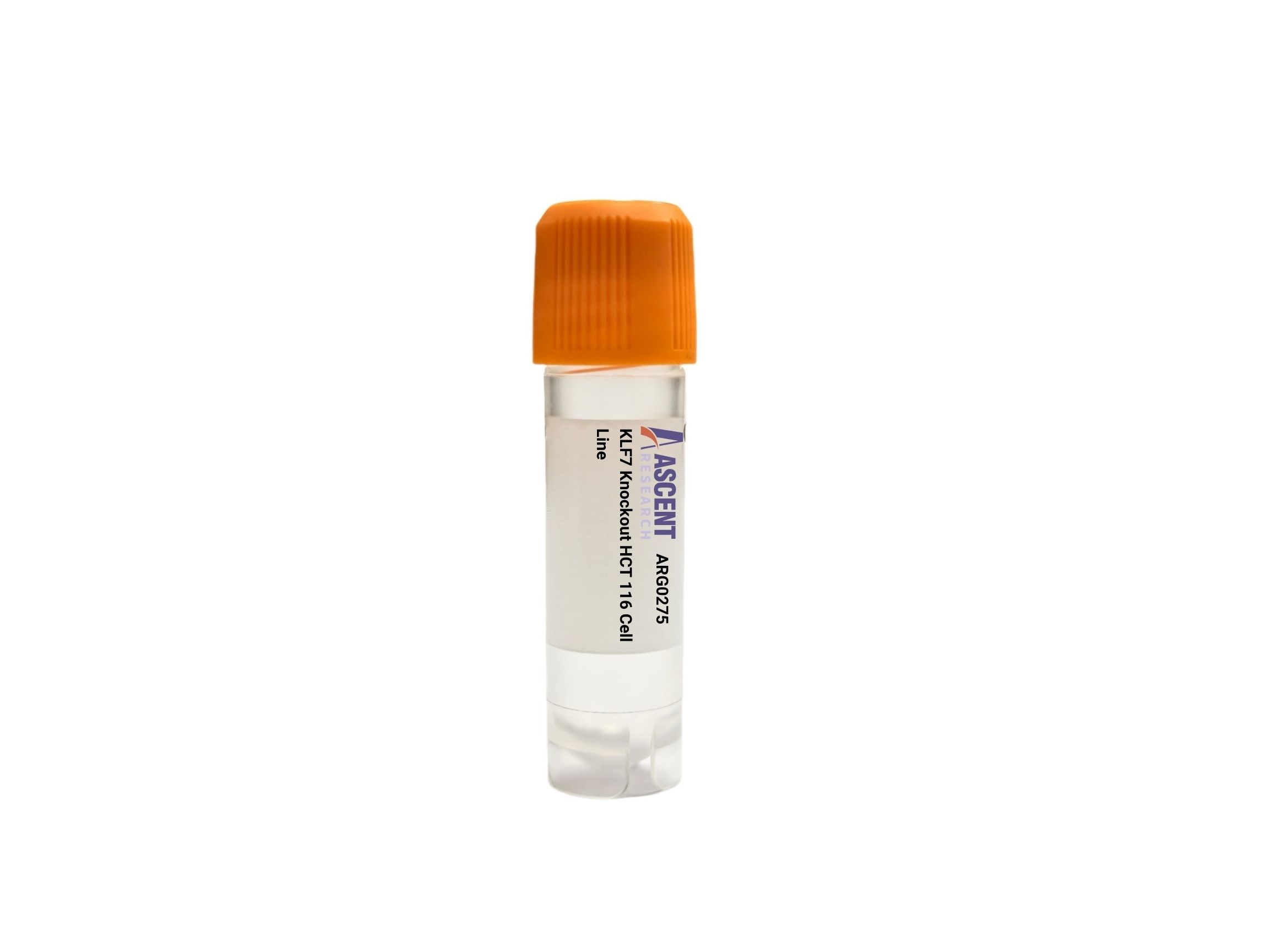
The KLF7 Knockout HCT 116 Cell Line is a CRISPR/Cas9-edited knockout cell line in the HCT 116 colorectal carcinoma background. KLF7 is a Kr??ppel-like factor transcription factor regulated by ??-catenin/TCF and TGF-?? signaling; it controls targets such as CDKN1A (p21) and CDH1 (E-cadherin) to modulate cell proliferation and adhesion. The host HCT 116 cells harbor KRAS G13D and mismatch repair mutations, providing a relevant model for colorectal cancer studies. This knockout line is designed for investigating KLF7 function in cell cycle regulation, apoptosis, migration, and drug response. Representative applications include RNA-seq, RT-qPCR, Western blotting, flow cytometry, and transwell assays. It is an essential tool for research on Wnt/??-catenin, MAPK/ERK, and PI3K/AKT pathway interactions in colorectal carcinoma.
 CDKN1B Knockout A2780 Polyclonal Cells
Cat. No. ARG19087
DDR1 Knockout SK-HEP-1 Polyclonal Cells
Cat. No. ARG15135
ANO6 Knockout Raji Polyclonal Cells
Cat. No. ARG21171
BICC1 Knockout jurkat Polyclonal Cells
Cat. No. ARG34006
ECI1 Knockout NCI-H1299 Polyclonal Cells
Cat. No. ARG40396
CC2D1B Knockout Raji Polyclonal Cells
Cat. No. ARG42841
CDKN1B Knockout A2780 Polyclonal Cells
Cat. No. ARG19087
DDR1 Knockout SK-HEP-1 Polyclonal Cells
Cat. No. ARG15135
ANO6 Knockout Raji Polyclonal Cells
Cat. No. ARG21171
BICC1 Knockout jurkat Polyclonal Cells
Cat. No. ARG34006
ECI1 Knockout NCI-H1299 Polyclonal Cells
Cat. No. ARG40396
CC2D1B Knockout Raji Polyclonal Cells
Cat. No. ARG42841
The KLF7 Knockout HCT 116 Cell Line is a CRISPR/Cas9-edited knockout cell line generated from the HCT 116 human colorectal carcinoma cell line. This loss-of-function model enables the study of KLF7, a Kr??ppel-like factor transcription factor, in a colorectal cancer context. The cell line is produced by CRISPR/Cas9-mediated disruption of the KLF7 gene, providing a stable, homogenous population suitable for reproducible functional assays.
HCT 116 is a well-characterized colorectal carcinoma cell line with mutations in MLH1 and MSH3 mismatch repair genes and a KRAS G13D oncogenic mutation, leading to microsatellite instability. Its epithelial morphology and robust growth support diverse in vitro applications, including proliferation, migration, and drug sensitivity assays. The KLF7 knockout derivative maintains the parental genetic background, allowing direct comparison with wild-type HCT 116 cells.
KLF7 functions as a context-dependent transcriptional activator or repressor that binds GC-rich promoter elements. It is regulated by upstream signals: the ??-catenin/TCF complex activates KLF7 expression downstream of Wnt, while TGF-??1 also induces it, and miR-181a represses it. KLF7 directly regulates targets including CDKN1A (p21), CDH1 (E-cadherin), and CCND1 (cyclin D1), thereby controlling cell cycle and adhesion. It interacts with co-regulators such as p300/CBP, SIN3A, and HDAC complexes. Through these interactions, KLF7 integrates inputs from Wnt/??-catenin, TGF-??/SMAD, MAPK/ERK, and PI3K/AKT pathways.
In the HCT 116 background, KLF7 knockout likely alters p21 and E-cadherin expression, potentially enhancing proliferation and invasion. The KRAS G13D mutation and mismatch repair deficiency may synergize with KLF7 loss to drive tumorigenic phenotypes via MAPK/ERK signaling. This cell line thus allows dissection of KLF7’s role in cell cycle checkpoints, apoptosis, and epithelial-mesenchymal transition, and its interplay with ??-catenin/TCF4 effectors. It also enables exploration of metabolic dysregulation links via ADIPOQ.
The KLF7 Knockout HCT 116 Cell Line is suited for cell proliferation (MTT), cell cycle (flow cytometry), apoptosis (Annexin V), and migration (transwell) assays. It can be used in RNA-seq, RT-qPCR, Western blotting, and immunofluorescence for gene and protein expression profiling. Luciferase reporter assays validate KLF7 transcriptional activity, while co-immunoprecipitation examines interactions with SMAD proteins or p300/CBP. This model is valuable for drug screens targeting MAPK, PI3K/AKT, or ??-catenin pathways, and for synthetic lethality studies in mismatch repair-deficient cancers. For further information, please contact Ascent Research.