Genome-edited Cells
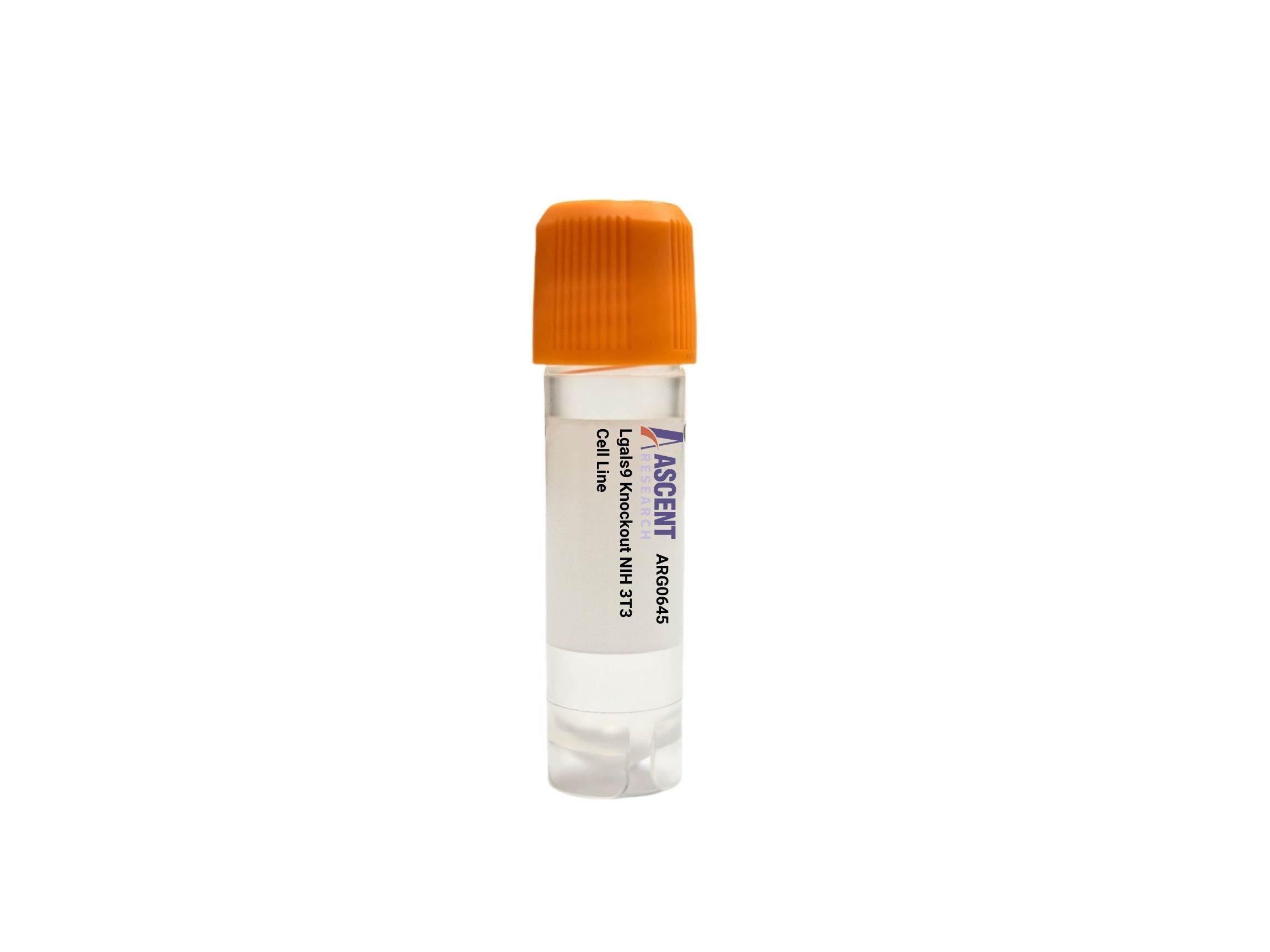
The Lgals9 Knockout NIH 3T3 Cell Line is a CRISPR/Cas9-engineered knockout cell line deficient in galectin-9, a beta-galactoside-binding lectin. Derived from spontaneously immortalized mouse embryonic fibroblasts, this model eliminates functional galectin-9 to enable detailed study of its immune-regulatory and adhesive functions. Galectin-9 interacts with Tim-3 and CD44, mediating T cell apoptosis and cell adhesion via caspase, mTOR, and AMPK pathways. This knockout line is ideal for immunology, cancer immunotherapy, and cell adhesion research, with applications in flow cytometry, western blotting, and apoptosis assays.
 GZF1 Knockout K562 Polyclonal Cells
Cat. No. ARG20523
OMA1 Knockout SK-HEP-1 Polyclonal Cells
Cat. No. ARG15450
FBXL18 Knockout Hela Polyclonal Cells
Cat. No. ARG8224
ABHD10 Knockout HAP1 Polyclonal Cells
Cat. No. ARG27177
AKAP11 Knockout HEK293T Polyclonal Cells
Cat. No. ARG37916
CSTF2T Knockout Hela Polyclonal Cells
Cat. No. ARG7771
GZF1 Knockout K562 Polyclonal Cells
Cat. No. ARG20523
OMA1 Knockout SK-HEP-1 Polyclonal Cells
Cat. No. ARG15450
FBXL18 Knockout Hela Polyclonal Cells
Cat. No. ARG8224
ABHD10 Knockout HAP1 Polyclonal Cells
Cat. No. ARG27177
AKAP11 Knockout HEK293T Polyclonal Cells
Cat. No. ARG37916
CSTF2T Knockout Hela Polyclonal Cells
Cat. No. ARG7771
The Lgals9 Knockout NIH 3T3 Cell Line is a CRISPR/Cas9-edited knockout cell line engineered to disrupt the murine Lgals9 gene encoding galectin-9. This cell line provides a loss-of-function model for studying galectin-9-dependent immune regulation, apoptosis, and cell adhesion in a mouse embryonic fibroblast background. The targeted gene disruption abolishes functional galectin-9 protein expression, enabling precise dissection of its role in signaling networks that govern T cell tolerance, inflammatory responses, and cellular survival pathways.
The host cell line, NIH 3T3, is a spontaneously immortalized embryonic fibroblast line derived from NIH Swiss mouse embryos. These cells are widely used in biomedical research due to their robust growth and ease of culture, providing a well-characterized model for studying signaling and adhesion. NIH 3T3 cells express key components of galectin-9-related pathways, including Tim-3 and CD44, making them a suitable platform for investigating galectin-9 function and its downstream effects.
Galectin-9, encoded by Lgals9, is a beta-galactoside-binding lectin that functions as a pivotal immune regulator. It interacts with T cell immunoglobulin and mucin domain-containing protein 3 (Tim-3/HAVCR2) and CD44, triggering distinct intracellular cascades. Binding to Tim-3 on T cells activates caspase-dependent apoptosis, contributing to immune tolerance and suppression of effector responses. This interaction is modulated by upstream signals including interferon-gamma (IFN-??) and Toll-like receptor (TLR) ligands, which induce Lgals9 expression via NF-??B. Additionally, galectin-9 engagement with CD44 enhances cell adhesion and can influence mTOR and AMPK signaling, linking metabolism to adhesion and autophagy. The galectin-9/Tim-3 axis is a central checkpoint in T cell receptor signaling, while its CD44 interaction governs cell-matrix dynamics.
In NIH 3T3 fibroblasts, Lgals9 knockout disrupts the endogenous galectin-9 network, providing a clean background to study galectin-9-mediated adhesion and its crosstalk with intracellular signaling. These fibroblasts lack T cell-specific machinery but express CD44 receptors, allowing focused investigation of galectin-9/CD44-driven adhesion, spreading, and downstream pathways such as AMPK/mTOR regulation. The knockout model is particularly valuable for dissecting how galectin-9 contributes to fibroblast-mediated immune modulation, as NIH 3T3 cells can be co-cultured with T cells to examine paracrine or juxtacrine effects on apoptosis. This system also helps elucidate galectin-9’s role in extracellular matrix interactions and fibrotic responses under inflammatory conditions, as IFN-?? and NF-??B activity can be manipulated in vitro.
Researchers can employ this knockout cell line in a variety of advanced assays to explore galectin-9 biology. Flow cytometry enables quantification of apoptosis markers and surface expression of adhesion molecules like CD44 following stimulation with IFN-?? or TLR agonists. Western blotting and immunofluorescence facilitate analysis of downstream targets including cleaved caspases, phosphorylated mTOR, and AMPK activation status. Co-immunoprecipitation experiments can validate interactions with Tim-3 or CD44 when co-expressed. T cell apoptosis assays using co-culture systems allow functional assessment of galectin-9/Tim-3-mediated immune regulation. Cell adhesion and spreading assays provide quantitative measures of galectin-9’s role in fibroblast attachment. These applications support research in autoimmunity, cancer immunotherapy, chronic inflammation, and viral pathogenesis. For further information, please contact Ascent Research.