Genome-edited Cells
Ascites
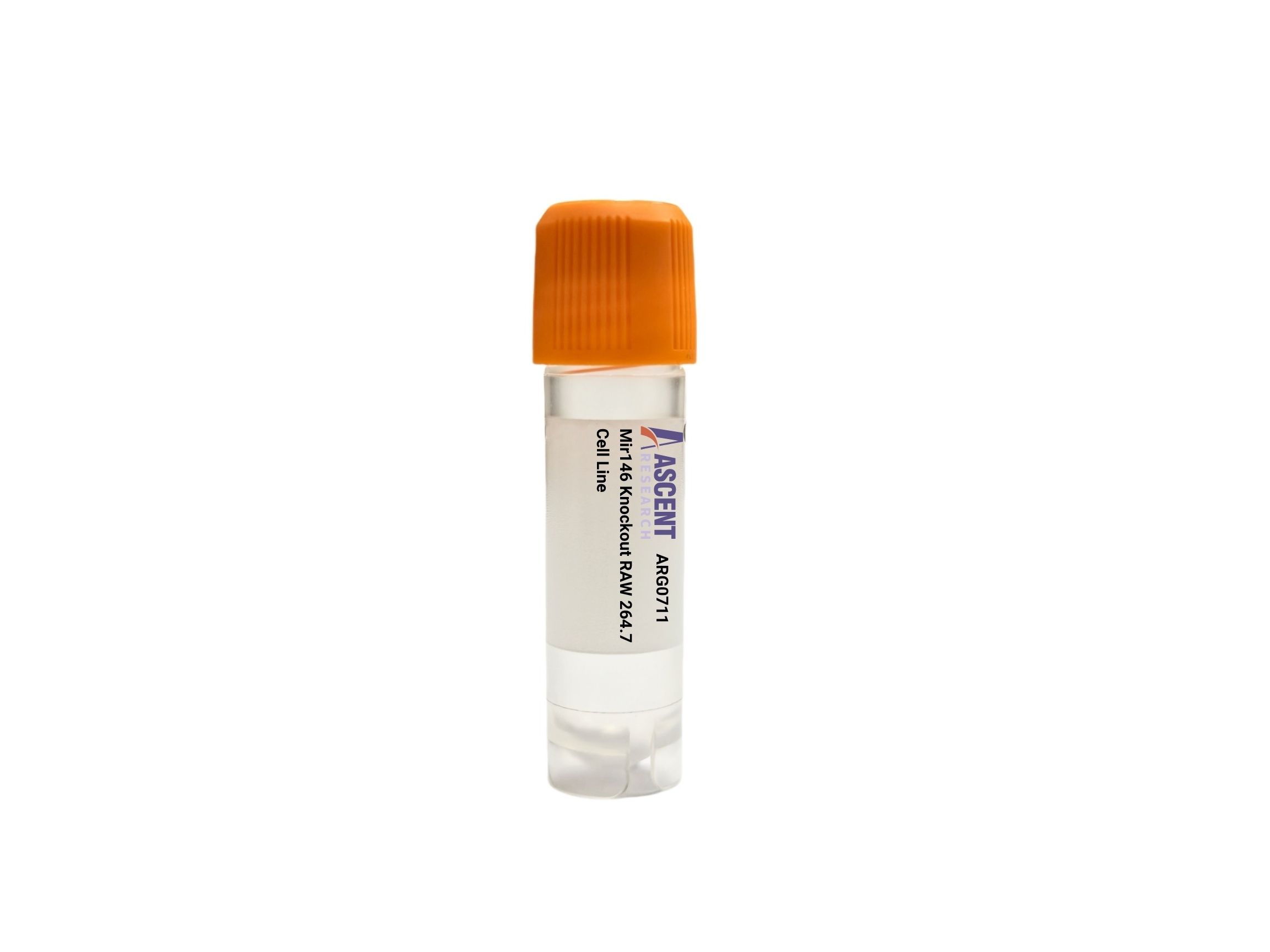
The Mir146 Knockout RAW 264.7 Cell Line is a CRISPR/Cas9-edited knockout mouse macrophage line with targeted disruption of the Mir146 gene. Loss of miR-146a, a microRNA that negatively regulates TLR/NF-??B signaling by targeting IRAK1 and TRAF6, creates a hyperinflammatory model ideal for studying innate immunity. This knockout cell line enables investigation of sustained NF-??B activation, cytokine production, and endotoxin tolerance. Derived from BALB/c macrophages, the line is suitable for NF-??B reporter assays, ELISA, western blotting, and RNA-seq. It supports research on inflammatory diseases, autoimmunity, and sepsis, as well as screening of anti-inflammatory compounds.
 CASP2 Knockout AGS Polyclonal Cells
Cat. No. ARG42416
GGCT Knockout A549 Polyclonal Cells
Cat. No. ARG11164
PGAM5 Knockout Raji Polyclonal Cells
Cat. No. ARG0889
KDM6A Knockout A2780 Polyclonal Cells
Cat. No. ARG29297
BLOC1S1 Knockout AGS Polyclonal Cells
Cat. No. ARG26758
OPA3 Knockout AGS Polyclonal Cells
Cat. No. ARG2777
CASP2 Knockout AGS Polyclonal Cells
Cat. No. ARG42416
GGCT Knockout A549 Polyclonal Cells
Cat. No. ARG11164
PGAM5 Knockout Raji Polyclonal Cells
Cat. No. ARG0889
KDM6A Knockout A2780 Polyclonal Cells
Cat. No. ARG29297
BLOC1S1 Knockout AGS Polyclonal Cells
Cat. No. ARG26758
OPA3 Knockout AGS Polyclonal Cells
Cat. No. ARG2777
The Mir146 Knockout RAW 264.7 Cell Line is a genetically engineered mouse macrophage line in which CRISPR/Cas9-mediated gene disruption has ablated functional miR-146a expression. This knockout cell line provides a robust loss-of-function model for dissecting miR-146a??s role as a negative regulator of innate immunity. By eliminating endogenous miR-146a, the model allows precise examination of TLR/NF-??B signaling dynamics and the autoregulatory feedback mechanisms that govern inflammatory responses.
The parental RAW 264.7 cell line originates from BALB/c mouse monocyte/macrophage cells transformed with Abelson murine leukemia virus. RAW 264.7 macrophages are extensively utilized in immunological research due to their capacity for phagocytosis, robust cytokine production, and sensitivity to TLR ligands such as LPS and cytokines like IL-1?? and TNF-??. This BALB/c-derived line serves as a physiologically relevant system for probing macrophage-mediated inflammation and innate immune signaling.
miR-146a is transcriptionally induced by NF-??B upon activation of TLR4 by LPS, as well as by IL-1?? and TNF-??. The primary transcript is processed by the DGCR8/Dicer microprocessor complex, and the mature miRNA is incorporated into the AGO2-containing RNA-induced silencing complex (RISC). miR-146a then binds the 3?? UTRs of IRAK1 and TRAF6 mRNAs, repressing their translation and promoting degradation. These adaptor proteins operate immediately downstream of MyD88 in the TLR pathway; their downregulation dampens IKK complex activity and NF-??B activation, establishing a negative feedback loop. In the knockout, the lack of miR-146a results in elevated IRAK1 and TRAF6 protein levels, sustained NF-??B signaling, and amplified expression of pro-inflammatory mediators.
In the RAW 264.7 context, knockout of Mir146 yields a hyperinflammatory phenotype characterized by prolonged NF-??B activity, increased secretion of cytokines like TNF-?? and IL-6, and defective endotoxin tolerance. This cellular state models key aspects of chronic inflammatory diseases, including rheumatoid arthritis, systemic lupus erythematosus, and sepsis, where miR-146a dysregulation is frequently observed. The model thus offers a powerful platform to dissect miR-146a-dependent regulatory nodes in macrophage activation.
Researchers can leverage this cell line for mechanistic studies using NF-??B luciferase reporters, cytokine ELISAs, western blotting for IRAK1 and TRAF6, and RNA-seq transcriptomic profiling. It is well suited for high-throughput screening of anti-inflammatory candidates, investigation of endotoxin tolerance, and validation of downstream targets such as STAT1, FADD, and NOX4. Additional applications include flow cytometry-based activation marker analysis and combinatorial studies with TLR agonists. For complete product details or ordering, contact Ascent Research.