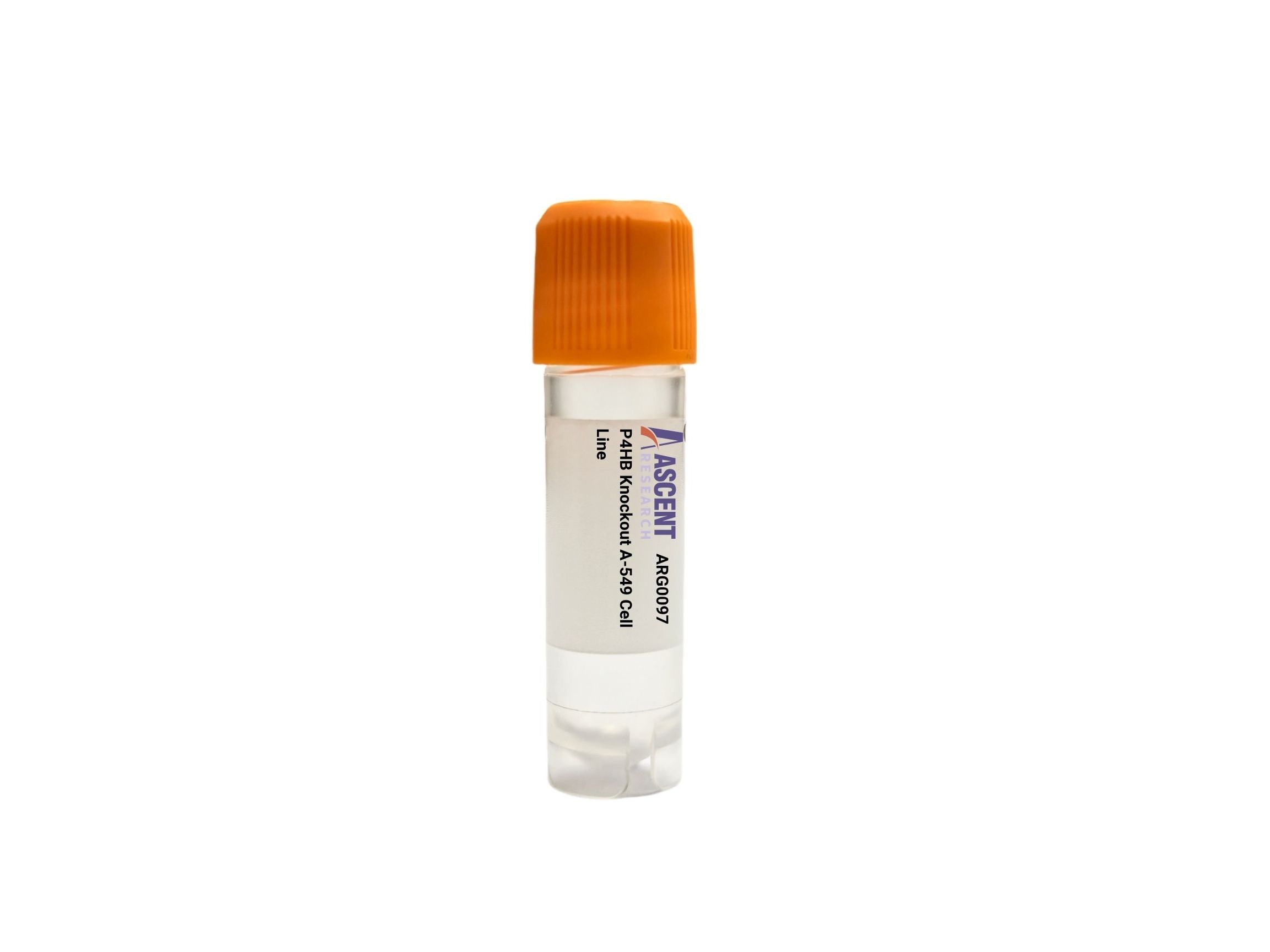
Genome-edited Cells
Lung
P4HB Knockout A-549 Cell Line is a human CRISPR/Cas9-edited alveolar epithelial carcinoma model with disruption of P4HB, which encodes protein disulfide-isomerase A1, a central ER oxidoreductase required for disulfide bond rearrangement and secretory protein quality control. In A-549 cells, this knockout supports analysis of ER proteostasis, redox homeostasis, and unfolded protein response signaling downstream of ATF6, ERN1/IRE1-XBP1, and EIF2AK3/PERK-ATF4, with relevance to HSPA5, DDIT3, EDEM1, and integrin-associated phenotypes. Applications include ER stress marker analysis, RNA-seq, non-reducing SDS-PAGE, ROS assays, secretion studies, apoptosis profiling, and lung cancer drug sensitivity testing.
 AMBRA1 Knockout SK-HEP-1 Polyclonal Cells
Cat. No. ARG32156
BICC1 Knockout jurkat Polyclonal Cells
Cat. No. ARG34006
GPT2 Knockout HAP1 Polyclonal Cells
Cat. No. ARG27510
MARCKSL1 Knockout A549 Polyclonal Cells
Cat. No. ARG10132
MTHFD1 Knockout MES-OV Polyclonal Cells
Cat. No. ARG6698
AMBRA1 Knockout SK-HEP-1 Polyclonal Cells
Cat. No. ARG32156
BICC1 Knockout jurkat Polyclonal Cells
Cat. No. ARG34006
GPT2 Knockout HAP1 Polyclonal Cells
Cat. No. ARG27510
MARCKSL1 Knockout A549 Polyclonal Cells
Cat. No. ARG10132
MTHFD1 Knockout MES-OV Polyclonal Cells
Cat. No. ARG6698
 Cd274 Knockout CT26 Cell Line
Cat. No. ARG0202
Cd274 Knockout CT26 Cell Line
Cat. No. ARG0202
P4HB Knockout A-549 Cell Line is a human CRISPR/Cas9-engineered knockout model in which the P4HB gene has been disrupted to eliminate functional P4HB expression. The parental A-549 line is a human alveolar epithelial carcinoma cell line, and this edited derivative provides a stable in vitro system for investigating the consequences of impaired endoplasmic reticulum oxidoreductase activity in a pulmonary epithelial cancer background. The model is intended for mechanistic studies of ER proteostasis, oxidative protein folding, secretory pathway function, and stress-adaptive signaling.
A-549 cells originate from human lung adenocarcinoma and are widely used to study pulmonary epithelial biology, tumor cell stress responses, and pharmacologic sensitivity in lung cancer. Because these cells retain strong relevance to epithelial secretory function, redox regulation, and ER stress signaling, they are frequently used in studies of unfolded protein response activation, proteotoxic injury, and anticancer responses. Their utility also extends to investigations of adhesion, migration, and extracellular matrix-related processes that are coupled to membrane and secreted protein maturation.
P4HB encodes protein disulfide-isomerase A1, a major ER thiol oxidoreductase and chaperone that catalyzes disulfide bond formation, reduction, and isomerization during maturation of nascent secretory and membrane proteins. P4HB also serves as the beta subunit of prolyl 4-hydroxylase, linking it to procollagen processing and extracellular matrix maturation through factors such as P4HA1 and P4HA2. Its expression and function are closely tied to ER stress pathways regulated by ATF6, ERN1/IRE1-XBP1, and EIF2AK3/PERK-ATF4, which are activated following HSPA5/BiP dissociation under proteotoxic conditions induced by tunicamycin, thapsigargin, hypoxia, or oxidative stress. P4HB interacts with ERO1A, HSPA5, CALR, CANX, PDIA3, and PDIA4 in oxidative folding and quality-control networks, and functions upstream of downstream outputs including HSPA5 induction, DDIT3/CHOP expression, EDEM1 and HERPUD1 upregulation, disulfide-bonded client protein maturation, integrin activation state, and apoptosis during unresolved ER stress.
In the A-549 background, loss of P4HB is a relevant strategy for examining how defective oxidative folding influences pulmonary epithelial tumor-cell behavior. This model can support studies of ER stress sensitivity, ROS balance, altered secretion-associated phenotypes, adhesion changes linked to integrin beta subunits, and pathway dependencies relevant to lung cancer, pulmonary fibrosis, connective tissue biology, and drug resistance.
This knockout cell line is suitable for western blotting and RT-qPCR analysis of UPR markers such as HSPA5, ATF4, XBP1, and DDIT3; RNA-seq profiling of ER stress and ER-associated degradation programs; immunofluorescence analysis of ER morphology or chaperone redistribution; and co-immunoprecipitation studies of PDI-network components. It is also useful for non-reducing SDS-PAGE analysis of disulfide-bonded proteins, ROS and glutathione measurements, secretion and proteostasis assays, apoptosis and viability studies following tunicamycin or thapsigargin exposure, and migration or invasion experiments examining adhesion-related consequences of altered integrin maturation. Researchers may contact Ascent Research for additional technical information, product details, or related gene-edited cell models.