Genome-edited Cells
Brain (left temporal lobe)
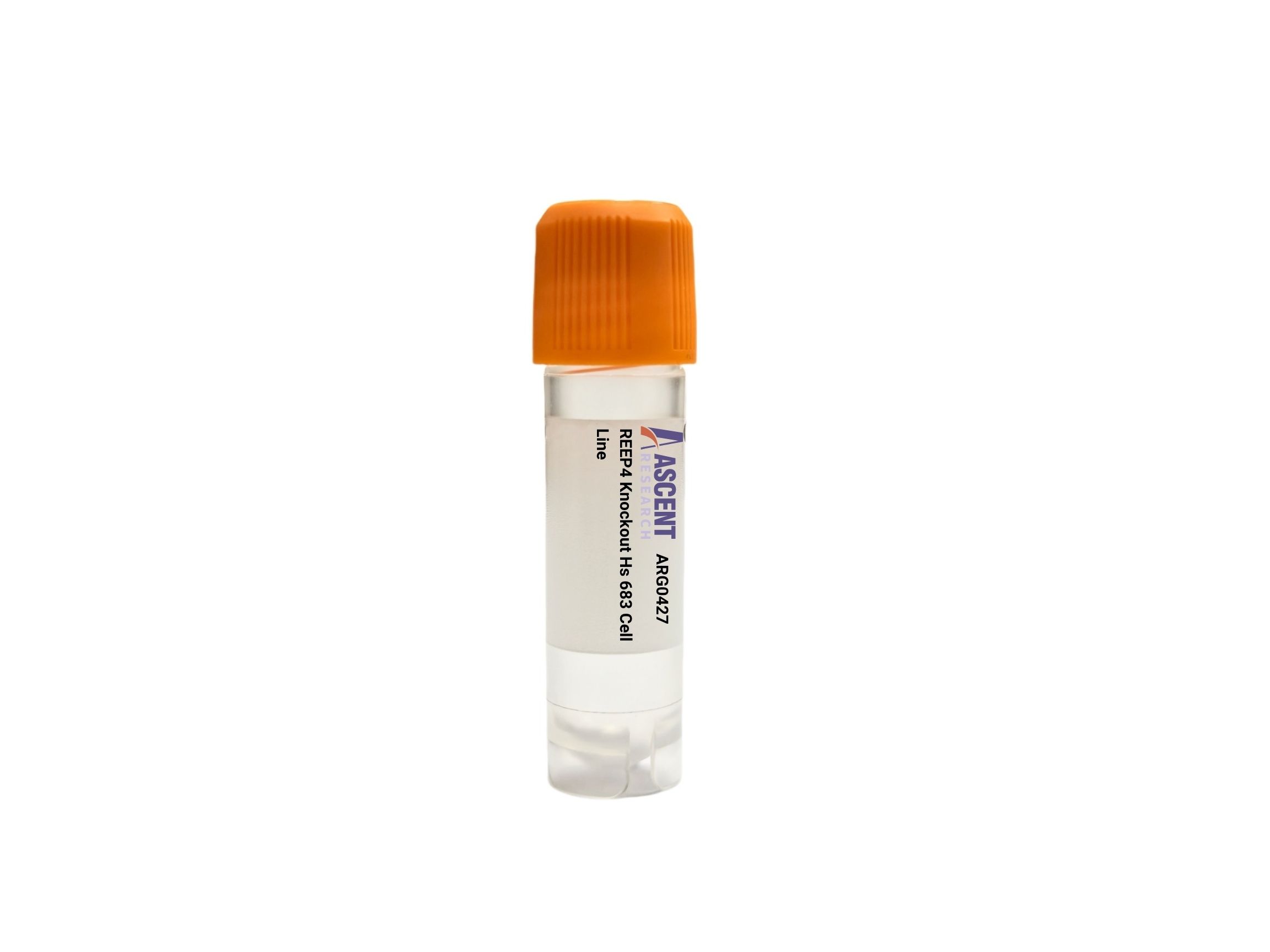
The REEP4 Knockout Hs 683 Cell Line is a CRISPR/Cas9-edited knockout model that disrupts REEP4, an ER?shaping protein that interacts with reticulon proteins and atlastin GTPases to regulate microtubule dynamics. Its loss induces ER stress, elevating CHOP and GRP78 through ATF4/XBP1, and impairs autophagy (LC3) and glioma cell migration. This Hs 683-derived cell line is applied in glioblastoma research, drug screening for ER stress modulators, and synthetic lethality studies. Typical readouts include immunofluorescence assays for ER morphology, Western blotting of UPR markers, and temozolomide sensitivity testing.
 BPIFB3 Knockout HAP1 Polyclonal Cells
Cat. No. ARG22123
FOXP3 Knockout DLD-1 Polyclonal Cells
Cat. No. ARG12127
ARMCX3 Knockout Hela Polyclonal Cells
Cat. No. ARG37300
CARM1 Knockout A549 Polyclonal Cells
Cat. No. ARG42333
BPIFB3 Knockout HAP1 Polyclonal Cells
Cat. No. ARG22123
FOXP3 Knockout DLD-1 Polyclonal Cells
Cat. No. ARG12127
ARMCX3 Knockout Hela Polyclonal Cells
Cat. No. ARG37300
CARM1 Knockout A549 Polyclonal Cells
Cat. No. ARG42333
 Rat Gingival Fibroblasts
Cat. No. ARP0402
Rat Gingival Fibroblasts
Cat. No. ARP0402
 SV2A Knockout SH-SY5Y Cell Line
Cat. No. ARG0741
SV2A Knockout SH-SY5Y Cell Line
Cat. No. ARG0741
The REEP4 Knockout Hs 683 Cell Line is a CRISPR/Cas9-edited human knockout cell line that eliminates REEP4 expression, creating a loss-of-function model for endoplasmic reticulum (ER) morphology and related processes. This targeted disruption of the ER?shaping protein REEP4 enables dissection of its roles in ER network organization, microtubule dynamics, and protein trafficking within a glioma background. The cell line provides a platform for mechanistic studies of ER stress pathways, autophagy, and tumor cell vulnerability.
The parental Hs 683 cell line is a neoplastic glial line isolated from a human left temporal lobe glioma. As a widely employed model of glioblastoma multiforme, Hs 683 cells exhibit key hallmarks of high-grade glioma, including rapid proliferation and invasive capacity. This background is particularly appropriate for investigating how REEP4 loss affects ER homeostasis and stress adaptation in the context of brain tumor biology.
REEP4 is a receptor expression?enhancing protein that associates with reticulon proteins, atlastin GTPases, and FAM134B to maintain ER tubule structure. It also binds microtubules, influencing cytoskeletal organization. In this knockout cell line, REEP4 disruption compromises ER architecture, activating the unfolded protein response (UPR). Consequently, the transcription factors ATF4 and XBP1s are induced, leading to elevated levels of CHOP, GRP78, and calnexin. Moreover, REEP4 loss perturbs autophagy, evidenced by altered LC3 processing, and disrupts microtubule?associated protein function. These molecular events position REEP4 at the interface of ER stress, protein homeostasis, and microtubule regulation.
In Hs 683 glioma cells, REEP4 knockout uncovers vulnerabilities linked to ER homeostasis. Glioma cells often face hypoxia and nutrient deprivation, conditions that exacerbate ER stress; REEP4 depletion therefore sensitizes them to ER stress inducers (tunicamycin, thapsigargin) and to the chemotherapeutic agent temozolomide. The knockout also attenuates cell migration. This model is valuable for examining how ER dynamics influence glioblastoma progression and drug resistance.
Applications include immunofluorescence imaging of ER morphology, Western blotting (CHOP, GRP78) and RT?qPCR (ATF4, XBP1s) for UPR markers, and LC3-based autophagy assays. Migration can be assessed by wound healing, viability by MTT, and apoptosis by flow cytometry. The cell line enables drug sensitivity profiling (e.g., temozolomide) and screening for ER stress modulators or synthetic lethal partners. For further information, contact Ascent Research.