Genome-edited Cells
Brain (temporal lobe)
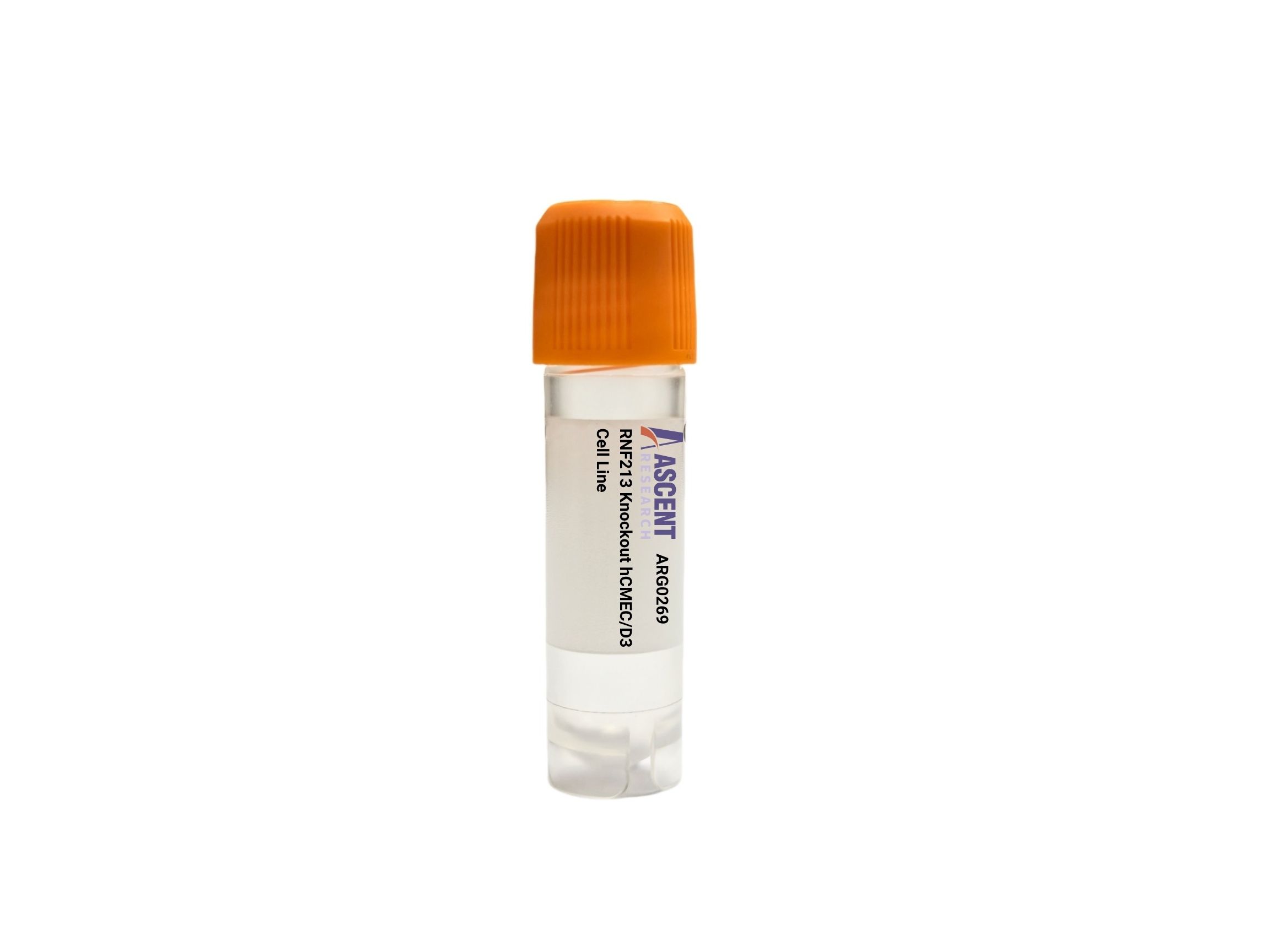
This CRISPR/Cas9-edited RNF213 knockout cell line is based on the hCMEC/D3 human cerebral microvascular endothelial host, a model of the blood-brain barrier. RNF213 encodes an E3 ubiquitin ligase that targets VEGFR2 for degradation, thereby regulating angiogenic signaling through NF-??B and Wnt/??-catenin pathways, with disruption linked to Moyamoya disease and stroke. Key applications include investigation of cerebrovascular pathogenesis, BBB function, and angiogenesis, supported by assays such as TEER measurement, tube formation, and ubiquitination studies. The knockout cell line provides a stable platform for dissecting RNF213-mediated endothelial regulation and drug permeability screening.
 PARD3B Knockout A549 Polyclonal Cells
Cat. No. ARG10770
DCTD Knockout A549 Polyclonal Cells
Cat. No. ARG10652
ITGAE Knockout HEK293T Polyclonal Cells
Cat. No. ARG26167
ANKS3 Knockout NCI-H1975 Polyclonal Cells
Cat. No. ARG31134
LIPA Knockout MCF7 Polyclonal Cells
Cat. No. ARG11458
PARD3B Knockout A549 Polyclonal Cells
Cat. No. ARG10770
DCTD Knockout A549 Polyclonal Cells
Cat. No. ARG10652
ITGAE Knockout HEK293T Polyclonal Cells
Cat. No. ARG26167
ANKS3 Knockout NCI-H1975 Polyclonal Cells
Cat. No. ARG31134
LIPA Knockout MCF7 Polyclonal Cells
Cat. No. ARG11458
 Rabbit Ovarian Theca Cell Medium
Cat. No. ARM0784
Rabbit Ovarian Theca Cell Medium
Cat. No. ARM0784
The RNF213 Knockout hCMEC/D3 Cell Line is a CRISPR/Cas9-mediated gene-disrupted cellular model generated from the immortalized human cerebral microvascular endothelial cell line hCMEC/D3. This product is supplied as a ready-to-use knockout cell line, enabling researchers to investigate the functional consequences of RNF213 loss in a well-characterized blood-brain barrier (BBB) system. The cell line offers a stable and reproducible platform for dissecting RNF213-dependent mechanisms without the variability associated with transient silencing approaches, making it suitable for both mechanistic studies and high-throughput applications.
hCMEC/D3 cells are derived from human cerebral microvascular endothelium and retain key BBB characteristics, including expression of tight junction proteins, polarised transport systems, and restricted paracellular permeability. This immortalized line serves as a robust in vitro model for studying cerebral endothelial biology, transendothelial transport, and neurovascular unit interactions. Its ability to form contact-inhibited monolayers with measurable barrier function makes it particularly valuable for drug permeability screening and investigations of vascular integrity under physiological and pathological conditions.
RNF213 encodes an E3 ubiquitin ligase that plays a critical role in angiogenesis and vascular development by selectively targeting the VEGFR2 (FLK1) receptor for ubiquitination and proteasomal degradation, thereby modulating VEGF signalling strength and duration. This activity is tightly regulated by upstream cues including IFN-??, TNF-??, and hypoxia. Downstream, RNF213 influences key pathways such as NF-??B and Wnt/??-catenin, and interacts with adapter proteins like filamin A (FLNA) as well as ubiquitin-conjugating enzymes and proteasome components. Within the angiogenic signalling network, RNF213 acts upstream of or in coordination with VEGFR2, AKT, ERK1/2, NF-??B, and ??-catenin, positioning it as a central node controlling endothelial cell proliferation, migration, and survival.
In the hCMEC/D3 background, RNF213 knockout perturbs the delicate balance of angiogenic signalling and barrier maintenance, reflecting its established role in cerebrovascular pathologies. Loss of RNF213 is strongly associated with Moyamoya disease, a progressive intracranial arterial stenosis disorder, as well as ischemic and hemorrhagic stroke. This model therefore provides a disease-relevant context for studying how dysregulated ubiquitination of VEGFR2 and altered downstream NF-??B and ??-catenin activity contribute to aberrant vascular remodelling and compromised BBB function. The cell line enables dissection of endothelial-autonomous mechanisms that may precede vessel occlusion or haemorrhage.
Researchers can employ this knockout cell line to explore Moyamoya disease pathogenesis, blood-brain barrier regulation, and angiogenic signalling in cerebral microvessels. Typical applications include tube formation assays to assess angiogenic capacity, transendothelial electrical resistance (TEER) measurements for barrier integrity, migration and proliferation analyses, and drug permeability screening. At the molecular level, western blotting, RT-qPCR, immunofluorescence, co-immunoprecipitation, and ubiquitination assays can be used to monitor changes in VEGFR2 stability, NF-??B activation, and partner protein interactions. For further details on characterization and availability, please contact Ascent Research.