Genome-edited Cells
Ascites
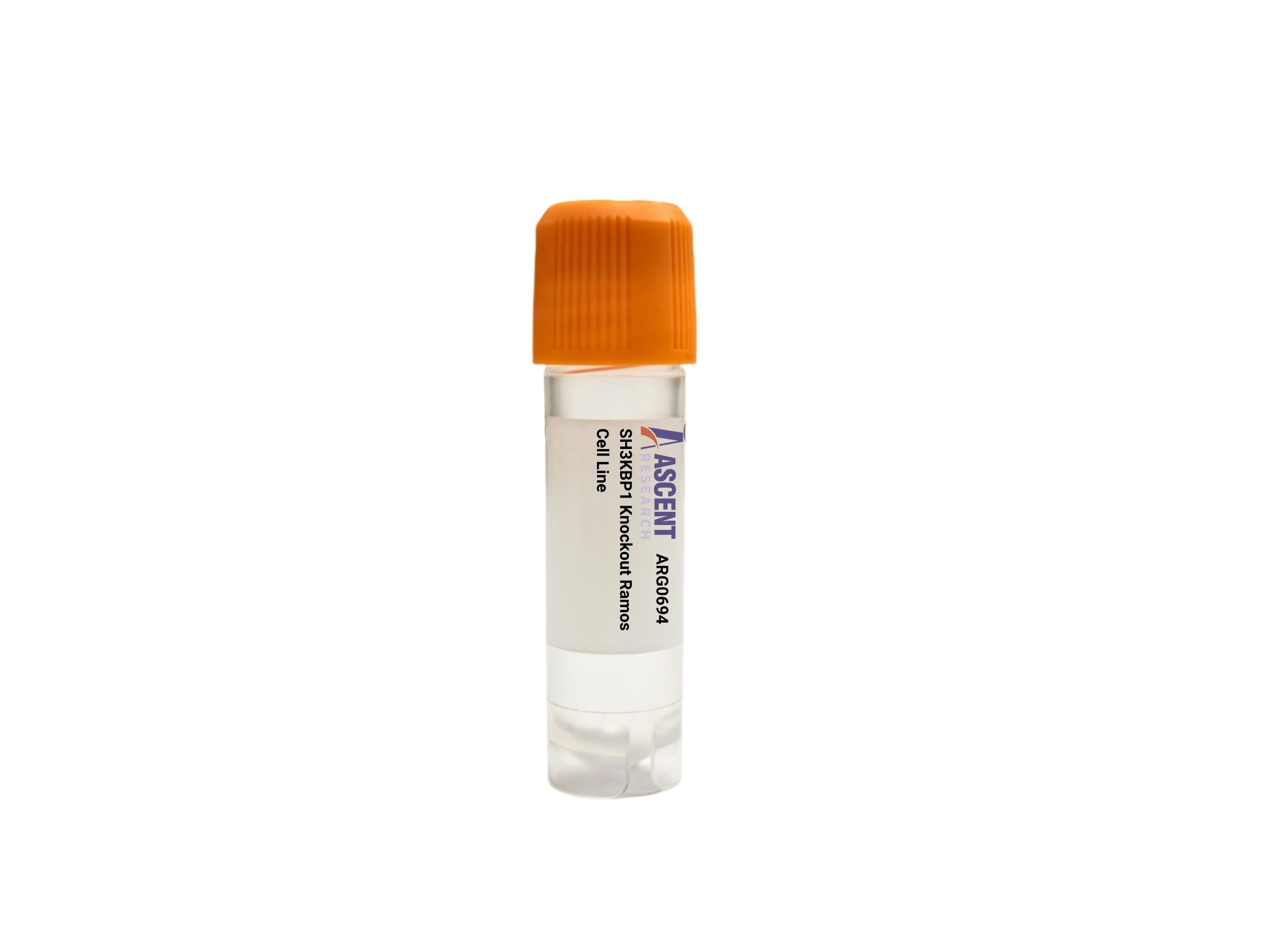
The SH3KBP1 Knockout Ramos Cell Line is a CRISPR/Cas9-edited human B lymphocyte model with targeted disruption of the SH3KBP1 gene. Derived from Burkitt??s lymphoma, this cell line enables investigation of the CIN85 adaptor protein in receptor tyrosine kinase (RTK) endocytosis and signaling. SH3KBP1 normally couples ubiquitinated RTKs to the endocytic machinery via Cbl and endophilin, and its loss leads to sustained AKT and ERK pathway activation. Typical applications include phospho-signaling analysis, RTK trafficking assays, co-immunoprecipitation studies, and drug sensitivity screens with RTK inhibitors. This knockout cell line is a valuable tool for functional genomics and drug discovery in B-cell malignancies and autoimmune disorders. For more information, please contact Ascent Research.
 FZD2 Knockout NCI-H1975 Polyclonal Cells
Cat. No. ARG16448
ABCB5 Knockout HAP1 Polyclonal Cells
Cat. No. ARG21547
MC5R Knockout KYSE30 Polyclonal Cells
Cat. No. ARG9668
CHST14 Knockout Raji Polyclonal Cells
Cat. No. ARG1133
FZD2 Knockout NCI-H1975 Polyclonal Cells
Cat. No. ARG16448
ABCB5 Knockout HAP1 Polyclonal Cells
Cat. No. ARG21547
MC5R Knockout KYSE30 Polyclonal Cells
Cat. No. ARG9668
CHST14 Knockout Raji Polyclonal Cells
Cat. No. ARG1133
 Human Schwann Cells
Cat. No. ARP0103
Human Schwann Cells
Cat. No. ARP0103
 CHST1 Knockout TE-1 Cell Line
Cat. No. ARG0787
CHST1 Knockout TE-1 Cell Line
Cat. No. ARG0787
The SH3KBP1 Knockout Ramos Cell Line is a CRISPR/Cas9-edited human B lymphocyte model with targeted disruption of the SH3KBP1 gene. This loss-of-function cell line provides a stable and heritable platform for studying the adaptor protein CIN85 in receptor tyrosine kinase (RTK) trafficking and signaling. Unlike transient silencing approaches, the engineered Ramos background ensures reproducible results in endocytosis assays, signaling experiments, and drug sensitivity screens relevant to lymphoma research.
The parental Ramos cell line derives from a human Burkitt??s lymphoma and serves as a well-characterized model of B lymphocyte biology. These cells exhibit features of germinal center B cells, including immunoglobulin expression and susceptibility to apoptotic and proliferative stimuli. Widely used in immunology and oncology, Ramos is ideal for studying molecular mechanisms of B-cell malignancies and evaluating therapeutic agents. The SH3KBP1 knockout derivative retains these host properties, enabling direct comparisons with isogenic wild-type controls to identify SH3KBP1-dependent phenotypes.
SH3KBP1 encodes the adaptor CIN85, which couples ubiquitinated RTKs to the endocytic machinery. It binds the E3 ligase Cbl, recognizing activated receptors like EGFR and c-MET, and recruits endophilin and dynamin for clathrin-mediated internalization. This promotes lysosomal degradation, attenuating downstream signaling. In the knockout, impaired clearance sustains surface RTK levels, enhancing AKT(Ser473) and ERK(Thr202/Tyr204) phosphorylation. SH3KBP1 also interacts with Grb2 and actin regulators, linking endocytosis to cytoskeletal remodeling and further modulating PI3K/AKT and MAPK/ERK pathways.
In Burkitt??s lymphoma, RTK signaling drives aberrant proliferation and survival. The SH3KBP1 Knockout Ramos Cell Line enables dissection of how defective endocytic RTK downregulation contributes to lymphomagenesis. As SH3KBP1 normally restricts oncogenic signaling, its loss may cause hypersensitivity to growth factors or resistance to receptor-targeted drugs. Researchers can utilize this model to assess the interplay between trafficking and signaling in B cells, identifying vulnerabilities in lymphomas and leukemias. The line is also pertinent to autoimmune diseases involving dysregulated B-cell RTK pathways.
Applications include biochemical analysis of RTK internalization/degradation via flow cytometry or surface biotinylation, phospho-specific western blotting for AKT and ERK activation, and co-immunoprecipitation of Cbl, endophilin, and Grb2. Functional assays using CellTiter-Glo viability, Annexin V apoptosis, and RTK inhibitor sensitivity screens can reveal drug response phenotypes. The SH3KBP1 Knockout Ramos Cell Line is an essential tool for functional genomics and drug discovery in B-cell malignancies. For more information, please contact Ascent Research.