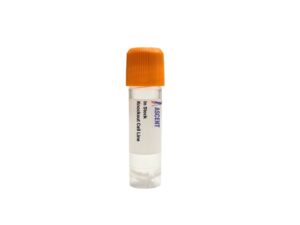
In Stock Cell Lines
Homo sapiens (Human)
Kidney
Adherent
The TFEB Knockout HEK293T Cell Line is a CRISPR/Cas9-edited knockout cell line that disrupts the TFEB gene in human HEK293T cells. TFEB is a master transcription factor regulating lysosomal biogenesis and autophagy through the CLEAR gene network. Its activity is controlled by mTORC1-mediated phosphorylation and 14-3-3 binding, with downstream targets including LAMP1 and SQSTM1/p62. This knockout model in the highly transfectable HEK293T background enables detailed mechanistic studies of nutrient-sensing pathways, lysosomal stress responses, and autophagy regulation. It is ideal for investigating lysosomal storage disorders, neurodegenerative diseases, and cancer metabolism, and can be employed in assays such as LC3 turnover, LysoTracker staining, and CLEAR reporter systems.
 FAM3A Knockout NCI-H1975 Polyclonal Cells
Cat. No. ARG17291
KLK14 Knockout HAP1 Polyclonal Cells
Cat. No. ARG23062
ITGB3BP Knockout HEK293T Polyclonal Cells
Cat. No. ARG26170
EIF2A Knockout K562 Polyclonal Cells
Cat. No. ARG40907
PHF10 Knockout 786-O Polyclonal Cells
Cat. No. ARG5294
FLNC Knockout HEK293T Polyclonal Cells
Cat. No. ARG4248
FAM3A Knockout NCI-H1975 Polyclonal Cells
Cat. No. ARG17291
KLK14 Knockout HAP1 Polyclonal Cells
Cat. No. ARG23062
ITGB3BP Knockout HEK293T Polyclonal Cells
Cat. No. ARG26170
EIF2A Knockout K562 Polyclonal Cells
Cat. No. ARG40907
PHF10 Knockout 786-O Polyclonal Cells
Cat. No. ARG5294
FLNC Knockout HEK293T Polyclonal Cells
Cat. No. ARG4248
The TFEB Knockout HEK293T Cell Line is a CRISPR/Cas9-edited knockout cell line enabling constitutive disruption of TFEB in human HEK293T cells. This loss-of-function model provides a defined system to investigate TFEB’s roles in lysosomal biology, autophagy, and metabolic regulation. By eliminating TFEB expression, researchers can dissect its transcriptional control over the Coordinated Lysosomal Expression and Regulation (CLEAR) network. The knockout line is a critical reagent for studying nutrient-sensing signaling, lysosomal stress responses, and diseases linked to lysosomal dysfunction, including neurodegenerative and metabolic disorders.
HEK293T cells are a clonal derivative of the HEK293 human embryonic kidney epithelial line, stably expressing the SV40 large T antigen for high-level episomal plasmid replication and robust protein expression, rendering them highly transfectable and suited for lentiviral production. The TFEB knockout in this background offers a versatile platform for reconstitution assays, structure?Cfunction analyses of TFEB, and comparative studies of wild-type versus mutant function. Its epithelial origin also provides a relevant context for examining TFEB in renal cell carcinoma and kidney pathophysiology.
TFEB is a master transcription factor binding CLEAR elements to regulate genes for lysosomal biogenesis, autophagy, and lipid catabolism. mTORC1 phosphorylates TFEB at the lysosome, promoting 14-3-3 binding and cytoplasmic retention; starvation or lysosomal stress triggers dephosphorylation and nuclear translocation, inducing targets such as LAMP1, CTSB, CTSD, ATP6V1H, ATG9B, UVRAG, and SQSTM1/p62. Additional upstream modulators include ERK2, PKC, and AMPK, while nuclear import depends on Rag GTPases, the Ragulator complex, and LAMTOR1. This knockout enables precise dissection of the mTORC1?CTFEB axis and CLEAR network.
Loss of TFEB in HEK293T impairs constitutive and stress-induced lysosomal/autophagic functions, offering a clean background for pathway analysis. The high transfectability allows introduction of wild-type or mutant TFEB to study phosphorylation, trafficking, and transcriptional synergy. With robust mTOR signaling, these cells are ideal for investigating nutrient sensing and crosstalk with growth factor pathways. Combining the knockout with mTOR inhibitors or lysosomotropic agents can dissect feedback mechanisms relevant to cancer drug resistance.
Applications include autophagy flux assays (LC3 turnover), lysosomal mass quantification (LysoTracker), and CLEAR target gene analysis (RT-qPCR, reporter assays). The line supports co-IP of TFEB?C14-3-3, mTORC1 activity assays (phospho-S6K1), and immunofluorescence tracking of reconstituted TFEB localization. Cell viability tests under starvation assess metabolic dependency. This knockout is essential for drug screening of autophagy modulators, TFEB nuclear translocation inhibitors, and therapies for lysosomal storage disorders and neurodegeneration. Contact Ascent Research for details.