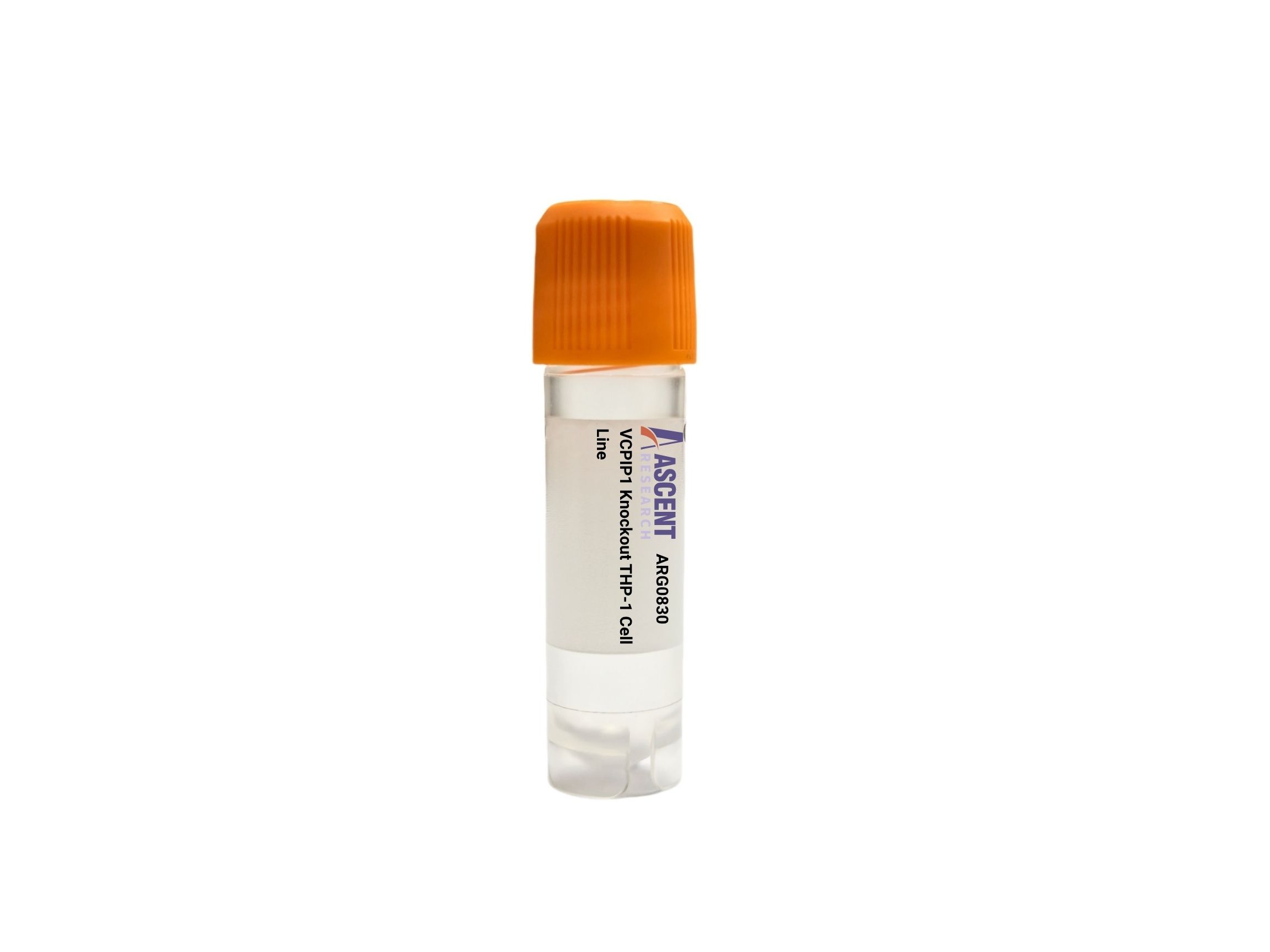
Genome-edited Cells
Blood (peripheral blood)
The VCPIP1 Knockout THP-1 Cell Line is a CRISPR/Cas9-edited knockout cell line in the human THP-1 monocytic leukemia background, providing a loss-of-function model for the deubiquitinating enzyme VCPIP1. VCPIP1 removes K48-linked ubiquitin from the p97/VCP?Cp47 complex, regulating Golgi reassembly and ER homeostasis. This cell line is ideal for studying ubiquitin-dependent membrane dynamics, ER stress, and myeloid cell biology, with applications in cancer and neurodegeneration research. Assays such as western blotting, immunofluorescence, and co-immunoprecipitation can probe VCPIP1 interactions with p97/VCP and p47, and assess consequences on Golgi morphology and ubiquitin profiles.
 NSD1 Knockout SK-HEP-1 Polyclonal Cells
Cat. No. ARG15401
NTN1 Knockout 143B Polyclonal Cells
Cat. No. ARG11931
IGFBP5 Knockout HAP1 Polyclonal Cells
Cat. No. ARG37032
CTNND1 Knockout Hela Polyclonal Cells
Cat. No. ARG7565
LDHD Knockout MES-OV Polyclonal Cells
Cat. No. ARG6048
PDK3 Knockout 786-O Polyclonal Cells
Cat. No. ARG5689
NSD1 Knockout SK-HEP-1 Polyclonal Cells
Cat. No. ARG15401
NTN1 Knockout 143B Polyclonal Cells
Cat. No. ARG11931
IGFBP5 Knockout HAP1 Polyclonal Cells
Cat. No. ARG37032
CTNND1 Knockout Hela Polyclonal Cells
Cat. No. ARG7565
LDHD Knockout MES-OV Polyclonal Cells
Cat. No. ARG6048
PDK3 Knockout 786-O Polyclonal Cells
Cat. No. ARG5689
The VCPIP1 Knockout THP-1 Cell Line is a CRISPR/Cas9-edited knockout cell line for loss-of-function studies of the VCPIP1 gene. This model features targeted gene disruption, abolishing endogenous VCPIP1 expression. It provides a stable platform to investigate consequences of VCPIP1 deficiency, avoiding the need for transient manipulations. Supplied as a ready-to-use cell line, it facilitates reproducible research in ubiquitin-dependent membrane dynamics and organelle homeostasis.
The THP-1 host cell line is a human monocytic leukemia model, originally derived from an acute monocytic leukemia (AML-M5) patient. THP-1 cells display monocyte-like features and can be differentiated into macrophage-like cells with PMA, enabling studies of monocyte/macrophage differentiation, inflammation, and innate immunity. Their leukemic background also supports cancer biology research, particularly hematological malignancies, making them a relevant platform for examining VCPIP1 in myeloid cell context.
VCPIP1 functions as a deubiquitinating enzyme that specifically removes K48-linked ubiquitin chains from the p97/VCP?Cp47 (NSFL1C) complex, essential for post-mitotic Golgi reassembly and ER homeostasis. Its activity is regulated by mitotic kinases (e.g., Cdk1) and the unfolded protein response (UPR). VCPIP1 interacts with p97/VCP, p47, UBXD1, and YOD1, modulating ubiquitination status of p97/VCP and Golgi tethering factors (GRASP65, GRASP55). This enzymatic activity ensures clearance of ubiquitinated substrates, linking the ubiquitin-proteasome system with organelle integrity.
In THP-1 cells, VCPIP1 knockout impairs deubiquitination of p97/p47, causing accumulation of ubiquitinated conjugates and defective Golgi membrane fusion. This triggers chronic ER stress and UPR activation, disrupting organelle homeostasis. Given the role of THP-1 cells in innate immunity, VCPIP1 loss may compromise secretory function and cytokine responses, providing a model to investigate connections between ubiquitin-dependent membrane trafficking and immune signaling. This system is also relevant to neurodegeneration and cancer, where VCPIP1 dysfunction is implicated.
Researchers can use this knockout line for ubiquitination profiling by western blot, Golgi morphology assessment via immunofluorescence, and cell cycle/apoptosis analysis by flow cytometry. Co-immunoprecipitation of p97/VCP and p47 monitors complex ubiquitination, while qRT-PCR of UPR targets (BiP, CHOP) and drug sensitivity assays (tunicamycin, thapsigargin) probe ER stress responses. This validated model advances investigation of VCPIP1 biology and screening of therapeutic candidates in cancer and neurodegeneration. For inquiries or custom solutions, contact Ascent Research.