Genome-edited Cells
Ascites
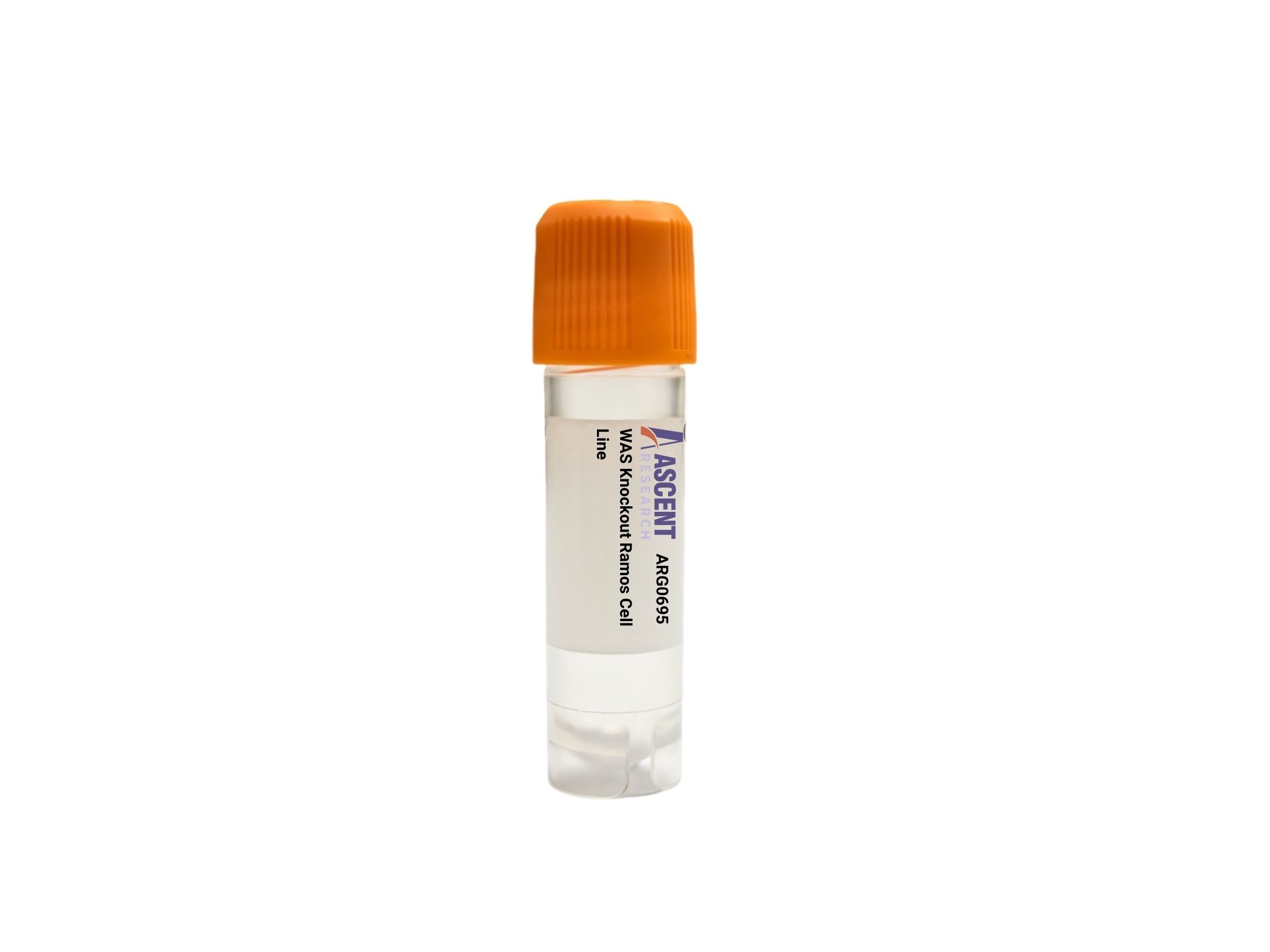
The WAS Knockout Ramos Cell Line is a CRISPR/Cas9-edited knockout human B lymphocyte line targeting WAS, the gene encoding WASP. Disruption of WASP impairs actin polymerization, B cell receptor signaling, and immune synapse formation. WASP acts downstream of CDC42 and partners with WIP and NCK to activate the ARP2/3 complex; its loss models Wiskott-Aldrich syndrome and X-linked thrombocytopenia. This cell line supports investigations into actin dynamics, B cell signaling, and immune dysregulation. Compatible with flow cytometry, actin polymerization assays, and phospho-signaling readouts, it enables detailed mechanistic studies in immunology and cancer biology.
 Immortalized Human Iliac Artery Endothelial Cell
Cat. No. ARI0315
Immortalized Human Iliac Artery Endothelial Cell
Cat. No. ARI0315
 LY96 Knockout Hela Polyclonal Cells
Cat. No. ARG8229
ASRGL1 Knockout MCF7 Polyclonal Cells
Cat. No. ARG36419
FNBP1 Knockout A549 Polyclonal Cells
Cat. No. ARG10045
ERG Knockout 786-O Polyclonal Cells
Cat. No. ARG5010
MID1 Knockout HEK293T Polyclonal Cells
Cat. No. ARG4331
LY96 Knockout Hela Polyclonal Cells
Cat. No. ARG8229
ASRGL1 Knockout MCF7 Polyclonal Cells
Cat. No. ARG36419
FNBP1 Knockout A549 Polyclonal Cells
Cat. No. ARG10045
ERG Knockout 786-O Polyclonal Cells
Cat. No. ARG5010
MID1 Knockout HEK293T Polyclonal Cells
Cat. No. ARG4331
The WAS Knockout Ramos Cell Line is a CRISPR/Cas9-edited knockout cell line derived from the human Ramos B lymphocyte line, engineered to disrupt the WAS gene. This loss-of-function model allows rigorous investigation of WASP-dependent actin polymerization and its roles in immune cell signaling, particularly B cell receptor (BCR) signaling, immune synapse formation, and lymphocyte motility. It provides a genetically defined tool for exploring WAS deficiency in a malignant B cell context.
The parental Ramos cell line is a Burkitt??s lymphoma-derived B lymphocyte line that retains key mature B cell features, including robust BCR signaling and antibody production. Its well-characterized signaling networks and genetic tractability make it ideal for knockout studies, enabling direct assessment of how WAS disruption impacts B cell responses and lymphomagenesis.
The WAS gene encodes WASP, a hematopoietic-specific actin nucleation-promoting factor that integrates upstream signals to control ARP2/3 complex-mediated actin polymerization. WASP is activated by CDC42 and PIP2, and its activity is modulated by SRC family kinases and BCR stimulation. Upon activation, WASP recruits and activates the ARP2/3 complex to drive branched actin assembly. Interacting partners such as WIP, NCK, and GRB2 regulate WASP stability and localization. Downstream, WASP-mediated actin dynamics promote filopodia formation and are essential for immune synapse architecture and cell motility.
In Ramos cells, WAS knockout severely impairs actin-dependent BCR signaling processes, including immune synapse formation, downstream kinase signaling, and cell migration. These defects recapitulate features of Wiskott-Aldrich syndrome and X-linked thrombocytopenia, establishing this line as a relevant model for these immunodeficiencies. Moreover, given WASP??s role in autoimmunity and hematologic malignancies, the model supports research into actin regulatory defects in tumor biology and immune dysregulation.
This knockout cell line is suitable for diverse applications, including Western blotting and RT-qPCR for gene disruption verification and pathway component analysis. Flow cytometry permits assessment of signaling readouts, while actin polymerization and cell migration assays probe cytoskeletal dynamics. Phospho-signaling analysis and immunofluorescence for F-actin facilitate detailed studies of BCR signaling and immune synapse remodeling. These tools collectively enable mechanistic dissection of WASP function in health and disease. For further information or to request a quote, please contact Ascent Research.