Genome-edited Cells
Lung
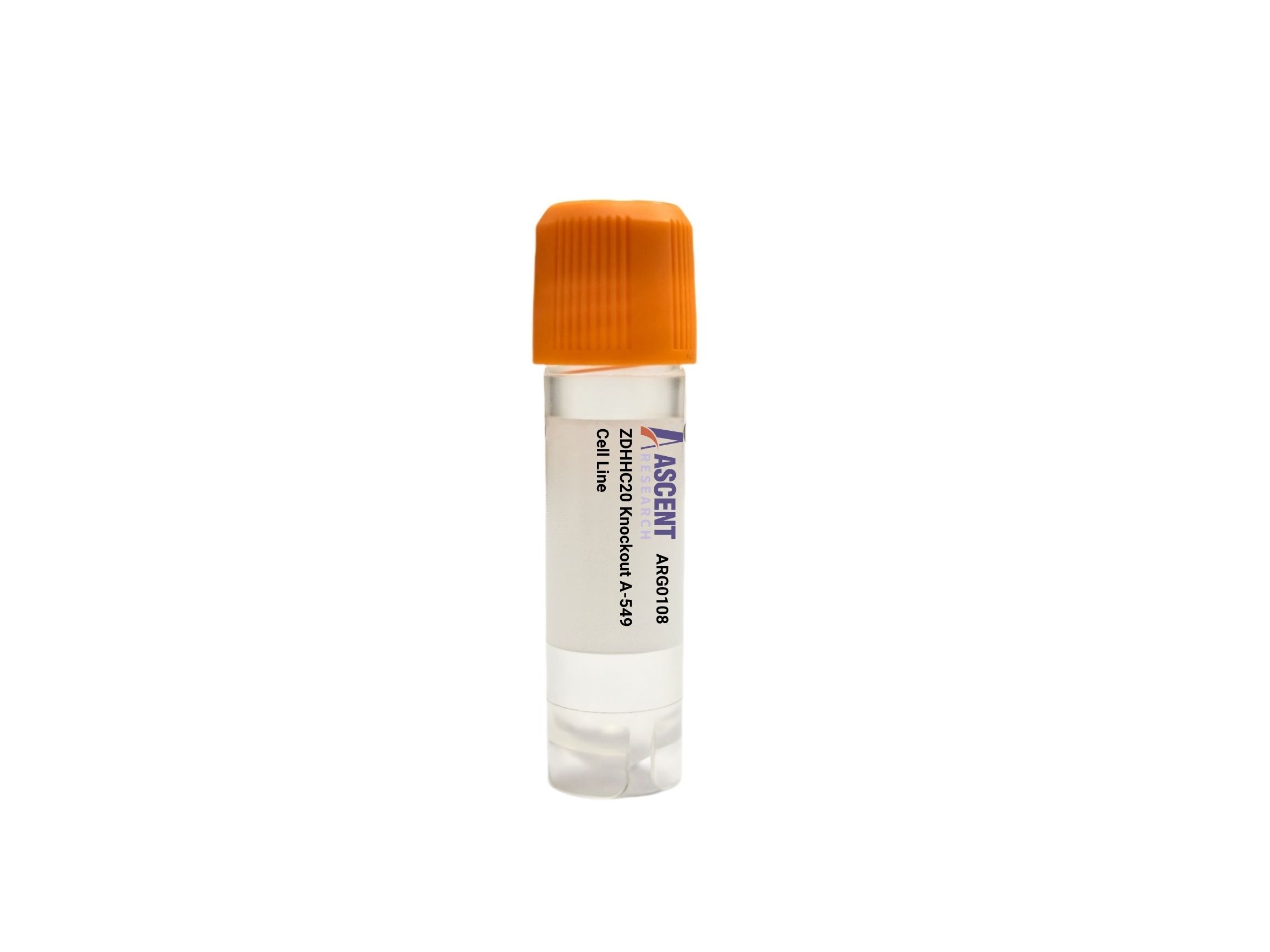
ZDHHC20 Knockout A-549 is a CRISPR/Cas9-edited human lung adenocarcinoma epithelial cell line with disruption of the DHHC palmitoyltransferase ZDHHC20. In the alveolar epithelial-like A-549 background, this model supports studies of S-palmitoylation-dependent membrane trafficking, EGFR localization and signaling, and downstream PI3K-AKT, MAPK-ERK, and YAP1/WWTR1-associated pathways. Relevant interacting factors include GOLGA7 and GOLGA7B. The cell line is useful for palmitoylation assays, phospho-signaling analysis, cell surface biotinylation, imaging, drug response studies, and viral infection research in lung cancer and epithelial signaling contexts.
 CSF2 Knockout HT29 Polyclonal Cells
Cat. No. ARG14181
CLSTN1 Knockout HT29 Polyclonal Cells
Cat. No. ARG14067
FOXO1 Knockout SKOV3 Polyclonal Cells
Cat. No. ARG12361
PEMT Knockout Hela Polyclonal Cells
Cat. No. ARG8617
KLK3 Knockout HAP1 Polyclonal Cells
Cat. No. ARG23065
BTN1A1 Knockout NCI-H1299 Polyclonal Cells
Cat. No. ARG36479
CSF2 Knockout HT29 Polyclonal Cells
Cat. No. ARG14181
CLSTN1 Knockout HT29 Polyclonal Cells
Cat. No. ARG14067
FOXO1 Knockout SKOV3 Polyclonal Cells
Cat. No. ARG12361
PEMT Knockout Hela Polyclonal Cells
Cat. No. ARG8617
KLK3 Knockout HAP1 Polyclonal Cells
Cat. No. ARG23065
BTN1A1 Knockout NCI-H1299 Polyclonal Cells
Cat. No. ARG36479
The ZDHHC20 Knockout A-549 Cell Line is a CRISPR/Cas9-engineered human cell model in which the ZDHHC20 gene has been disrupted to eliminate functional gene expression. This stable knockout line is generated in A-549 cells, a human lung adenocarcinoma epithelial cell line with alveolar epithelial-like features. It provides an in vitro system for investigating the consequences of losing a DHHC-domain palmitoyl acyltransferase in a respiratory epithelial cancer context, with particular relevance to membrane-associated signaling, protein trafficking, and post-translational lipid modification.
A-549 cells are widely used as a model of human lung epithelium and epithelial tumor biology. Derived from lung adenocarcinoma, they are routinely applied to studies of receptor signaling, membrane dynamics, proliferation, survival, and host-pathogen interactions. Their utility in respiratory biology and cancer research makes them well suited for examining pathways that depend on plasma membrane organization and endomembrane trafficking. In addition, A-549 cells are commonly used in infection models, including studies of viral entry and replication, where membrane composition and receptor localization can strongly influence cellular susceptibility and response.
ZDHHC20 encodes a Golgi-associated palmitoyl acyltransferase that catalyzes S-palmitoylation of selected membrane-associated proteins. Through this activity, ZDHHC20 regulates membrane retention, intracellular trafficking, protein stability, and signaling competence of palmitoylated cargo. ZDHHC20 functions in the protein S-palmitoylation cycle together with interacting factors including GOLGA7 and GOLGA7B, and its substrates are counter-regulated by acyl-protein thioesterases such as LYPLA1 and LYPLA2. In epithelial signaling networks, ZDHHC20 has mechanistic relevance to EGFR membrane localization and signaling output, with downstream consequences for KRAS-RAF1-MAPK1/MAPK3 and PIK3CA-AKT1 pathway activity, as well as YAP1 and WWTR1-associated Hippo pathway regulation. Its expression and activity are influenced by growth factor signaling, EGFR activation, cellular stress responses, and transcriptional programs linked to lipid metabolism and membrane trafficking.
In the A-549 background, loss of ZDHHC20 provides a useful model for interrogating how palmitoylation-dependent membrane control contributes to lung cancer cell phenotypes. Because A-549 cells are frequently used to study EGFR-linked signaling and epithelial behavior, disruption of ZDHHC20 can help define how altered palmitoylation reshapes receptor residence at the plasma membrane, endomembrane organization, proliferative signaling, survival responses, and migration-associated phenotypes. This context is also relevant to viral infection research, where changes in membrane protein trafficking and fusion-related processes may influence host-cell interactions with respiratory viruses.
This knockout line is suitable for mechanistic studies using western blotting, RT-qPCR, phospho-signaling analysis, and RNA-seq to assess pathway adaptation after ZDHHC20 loss. Acyl-biotin exchange, acyl-resin-assisted capture, and metabolic labeling of palmitoylation can be used to profile changes in S-palmitoylated proteins, while co-immunoprecipitation and immunofluorescence microscopy support analysis of interactions with GOLGA7/GOLGA7B and subcellular localization of EGFR or other membrane cargo. Cell surface biotinylation assays can quantify receptor plasma membrane residence, and proliferation, apoptosis, migration, drug sensitivity, and viral infection assays enable phenotype-driven interrogation of pathway dependency and therapeutic response. Researchers may contact Ascent Research for additional technical information, product details, or related gene-edited cell models.