Genome-edited Cells
Blood (peripheral blood)
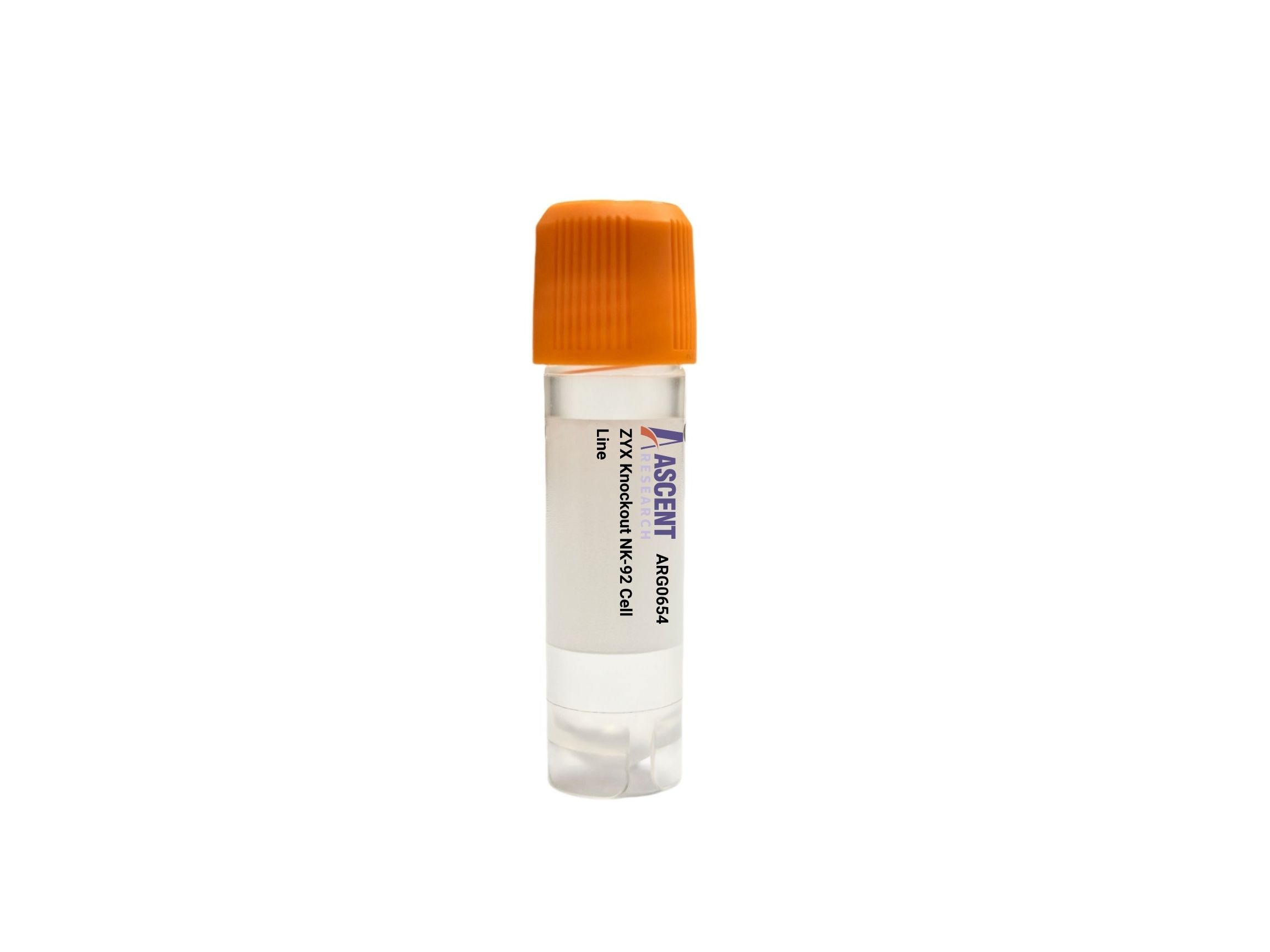
The ZYX Knockout NK-92 Cell Line is a CRISPR/Cas9-edited loss-of-function model featuring targeted disruption of the ZYX gene in the interleukin-2-dependent NK-92 natural killer cell line. Zyxin, encoded by ZYX, is a LIM domain mechanotransducer at focal adhesions that coordinates actin cytoskeletal remodeling and signal transduction. By interacting with vinculin, Ena/VASP proteins, and ??-actinin, zyxin modulates NK cell adhesion, migration, and immune synapse stability, ultimately influencing YAP/TAZ nuclear localization. This knockout line provides a critical tool for investigating NK cell mechanobiology, tumor infiltration, and immunotherapy target discovery.
 CFH Knockout A549 Polyclonal Cells
Cat. No. ARG11176
KYNU Knockout AGS Polyclonal Cells
Cat. No. ARG27145
INHBE Knockout Lovo Polyclonal Cells
Cat. No. ARG36391
IL11 Knockout HGC-27 Polyclonal Cells
Cat. No. ARG36138
MCF2L Knockout HCT116 Polyclonal Cells
Cat. No. ARG7144
LRWD1 Knockout MES-OV Polyclonal Cells
Cat. No. ARG6114
CFH Knockout A549 Polyclonal Cells
Cat. No. ARG11176
KYNU Knockout AGS Polyclonal Cells
Cat. No. ARG27145
INHBE Knockout Lovo Polyclonal Cells
Cat. No. ARG36391
IL11 Knockout HGC-27 Polyclonal Cells
Cat. No. ARG36138
MCF2L Knockout HCT116 Polyclonal Cells
Cat. No. ARG7144
LRWD1 Knockout MES-OV Polyclonal Cells
Cat. No. ARG6114
The ZYX Knockout NK-92 Cell Line is a CRISPR/Cas9-edited knockout cell line featuring targeted disruption of the ZYX gene in the NK-92 natural killer cell background. This loss-of-function model enables precise investigation of zyxin-dependent processes without altering other genomic loci. The product is supplied as a ready-to-use cell line, validated for gene disruption and suitable for functional studies in immunology and cancer research.
The NK-92 cell line is an interleukin-2 (IL-2)-dependent human natural killer cell line derived from a male patient with non-Hodgkin’s lymphoma. NK-92 cells express characteristic NK markers such as CD56, CD2, and CD7, and display robust innate cytotoxicity against tumor and virally infected cells. This well-characterized model is widely employed to study NK cell biology, cytotoxicity mechanisms, and immunotherapeutic strategies.
The ZYX gene encodes zyxin, a LIM domain protein that localizes to focal adhesions and actin stress fibers, serving as a mechanosensitive scaffold. Zyxin functions at the nexus of integrin signaling and actin cytoskeleton regulation, acting downstream of mechanical stretch, integrin engagement, RhoA, and Src kinase. It interacts with vinculin, paxillin, talin, Ena/VASP proteins, and ??-actinin to modulate actin dynamics. Zyxin also mediates Hippo pathway cross-talk, influencing YAP/TAZ nuclear localization.
In NK-92 cells, zyxin is implicated in adhesion, migration, and immune synapse formation??processes essential for cytotoxic degranulation and target cell killing. Disruption of ZYX in this background is anticipated to perturb focal adhesion integrity and mechanotransduction, potentially impairing NK cell motility and lytic function. This model is therefore valuable for dissecting the molecular underpinnings of NK cell-mediated tumor surveillance and for exploring how adhesive and mechanical cues regulate lymphocyte effector responses.
Key applications include investigating NK cell adhesion and migration via Transwell assays, studying mechanotransduction in lymphocyte function with actin cytoskeleton staining, and screening for cancer immunotherapies using calcein-AM release cytotoxicity assays. Further experiments may involve co-immunoprecipitation of zyxin with vinculin, immunofluorescence for focal adhesion localization, and flow cytometry for activation markers. This knockout line supports target validation for enhancing NK cell persistence and tumor infiltration. For further information, please contact Ascent Research.