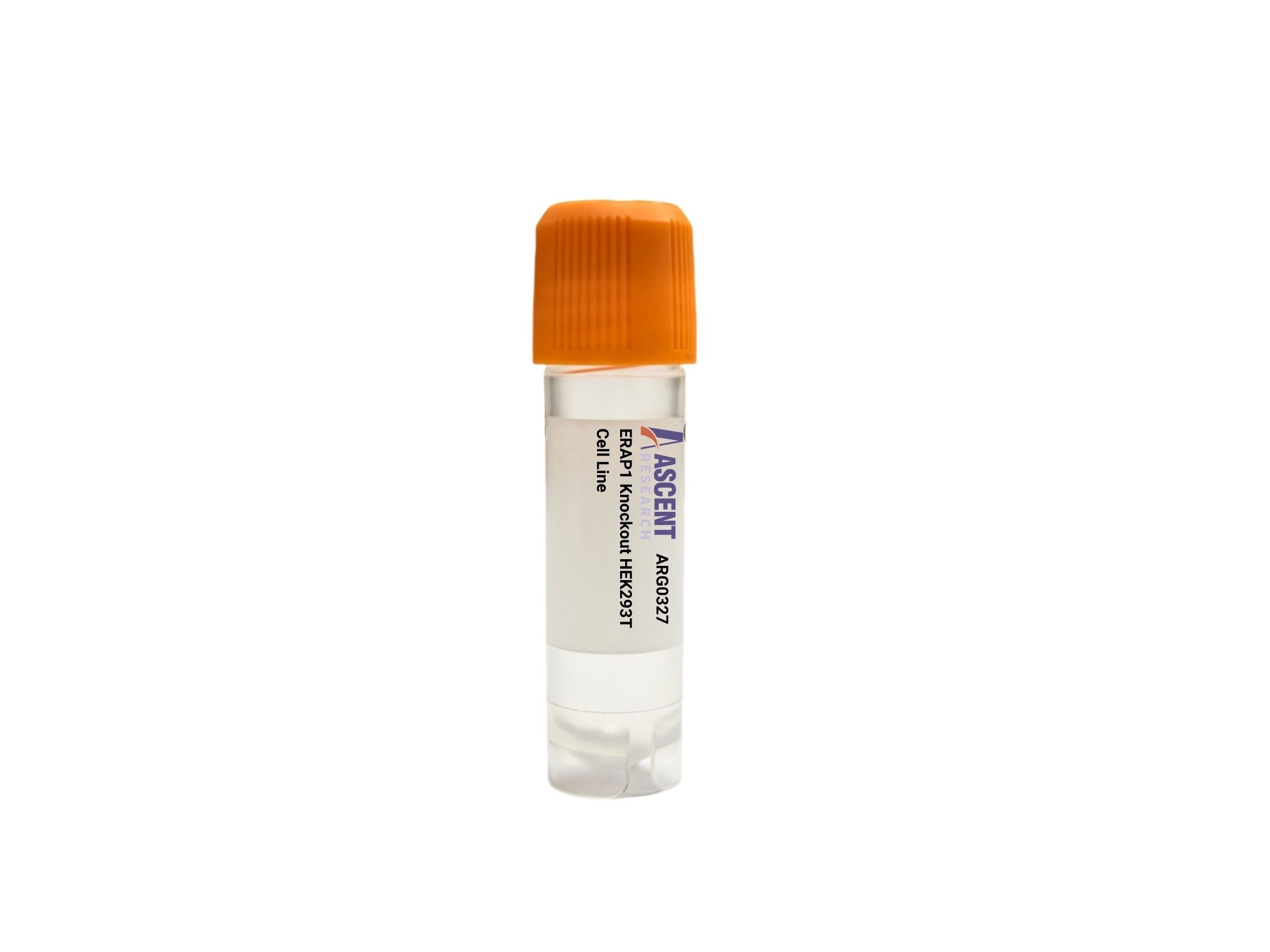
Genome-edited Cells
Kidney
CRISPR/Cas9-edited ERAP1 knockout HEK293T cell line providing a loss-of-function model for the endoplasmic reticulum aminopeptidase that trims antigenic peptides for MHC class I presentation and processes vasoactive substrates. By disrupting ERAP1, this line enables study of peptide-loading complex interactions with Tapasin, Calreticulin, and ERp57, and the regulation of surface MHC class I expression. Ideal for investigating antigen processing, modeling autoimmune diseases like ankylosing spondylitis and psoriasis, screening ERAP1 inhibitors, and dissecting the renin?Cangiotensin system. The HEK293T host offers high transfection efficiency for reconstitution studies. Suitable for Western blotting, flow cytometry, peptide trimming assays, and cytokine stimulation assays.
 CUL4A Knockout A2780 Polyclonal Cells
Cat. No. ARG18557
LHFPL2 Knockout NCI-H1975 Polyclonal Cells
Cat. No. ARG16749
ARID1B Knockout HT29 Polyclonal Cells
Cat. No. ARG33033
AAMP Knockout HAP1 Polyclonal Cells
Cat. No. ARG34934
DLAT Knockout SK-HEP-1 Polyclonal Cells
Cat. No. ARG38865
CUL4A Knockout A2780 Polyclonal Cells
Cat. No. ARG18557
LHFPL2 Knockout NCI-H1975 Polyclonal Cells
Cat. No. ARG16749
ARID1B Knockout HT29 Polyclonal Cells
Cat. No. ARG33033
AAMP Knockout HAP1 Polyclonal Cells
Cat. No. ARG34934
DLAT Knockout SK-HEP-1 Polyclonal Cells
Cat. No. ARG38865
 Rat Trabecular Meshwork Cell Medium
Cat. No. ARM0411
Rat Trabecular Meshwork Cell Medium
Cat. No. ARM0411
The ERAP1 Knockout HEK293T Cell Line is a CRISPR/Cas9-edited knockout cell product in which the human ERAP1 gene has been disrupted to establish a stable loss-of-function model. This cell line is generated from the HEK293T host background and provides a genetically defined system for investigating endoplasmic reticulum aminopeptidase 1 (ERAP1) function. The knockout is achieved through targeted gene disruption without specification of the editing pattern, ensuring a consistent and reproducible ablation of ERAP1 expression. The product is supplied as a viable, proliferating cell line suitable for a broad range of biochemical, immunological, and pharmacological studies. Researchers can employ this model to dissect ERAP1-dependent processes with high reproducibility.
The HEK293T host cell line originates from human embryonic kidney epithelial cells and is derived from the parental HEK293 line by stable integration of the SV40 large T antigen. This modification confers high transfection efficiency and robust protein expression capabilities, making HEK293T a widely utilized platform for functional genomics, recombinant protein production, and lentiviral packaging. The epithelial origin and kidney derivation are particularly relevant for studies intersecting with renal physiology and peptide hormone processing. Additionally, HEK293T cells express key components of the antigen presentation machinery, allowing reconstitution of MHC class I pathways upon introduction of appropriate factors. Their ease of culture and genetic manipulation simplifies the generation of knockout derivatives and subsequent phenotypic analyses.
ERAP1 is an endoplasmic reticulum-resident aminopeptidase that trims antigenic peptide precursors to optimal lengths for binding to MHC class I molecules, a critical step in CD8+ T cell-mediated immunity. Its activity is transcriptionally regulated by pro-inflammatory cytokines such as IFN-?? and TNF-??, acting through NF-??B signaling. ERAP1 interacts directly with the peptide-loading complex components tapasin, calreticulin, and ERp57, and associates with the MHC class I heavy chain to optimize peptide repertoire. Beyond antigen processing, ERAP1 cleaves vasoactive substrates including angiotensin II, thus participating in the renin?Cangiotensin system. Representative pathway elements include the proteasome, TAP transporter, beta-2-microglobulin, renin, ACE, and angiotensinogen. ERAP1 therefore bridges adaptive immunity and blood pressure regulation.
In the HEK293T context, the ERAP1 knockout provides a simplified epithelial model to study the molecular mechanisms of peptide trimming and MHC class I loading without the complexity of professional antigen-presenting cells. The high transfection efficiency of this host permits reconstitution with wild-type or mutant ERAP1 variants, enabling structure?Cfunction analyses. Because HEK293T cells endogenously express MHC class I heavy chains and antigen-processing machinery, the knockout line can be used to measure alterations in surface MHC class I expression and peptide repertoire by flow cytometry or immunopeptidomics. This model is particularly advantageous for screening cytokine-dependent induction pathways, given that IFN-?? and TNF-?? responses remain intact. Consequently, it serves as a versatile tool for both mechanistic dissection and translational research.
Typical research applications include investigation of MHC class I antigen processing pathways, functional characterization of aminopeptidase catalytic activity, and modeling of ERAP1-associated autoimmune conditions such as ankylosing spondylitis, psoriasis, and Beh?et??s disease. The cell line is also suited for drug screening campaigns aimed at identifying ERAP1 inhibitors and for exploring the aminopeptidase’s role in blood pressure regulation. Representative assays include Western blotting for protein expression, flow cytometric quantification of surface MHC class I, RT-qPCR and RNA-seq for transcriptional profiling, peptide trimming enzyme assays, cytokine stimulation experiments with IFN-?? or TNF-??, and CD8+ T cell activation readouts. For more information, contact Ascent Research.